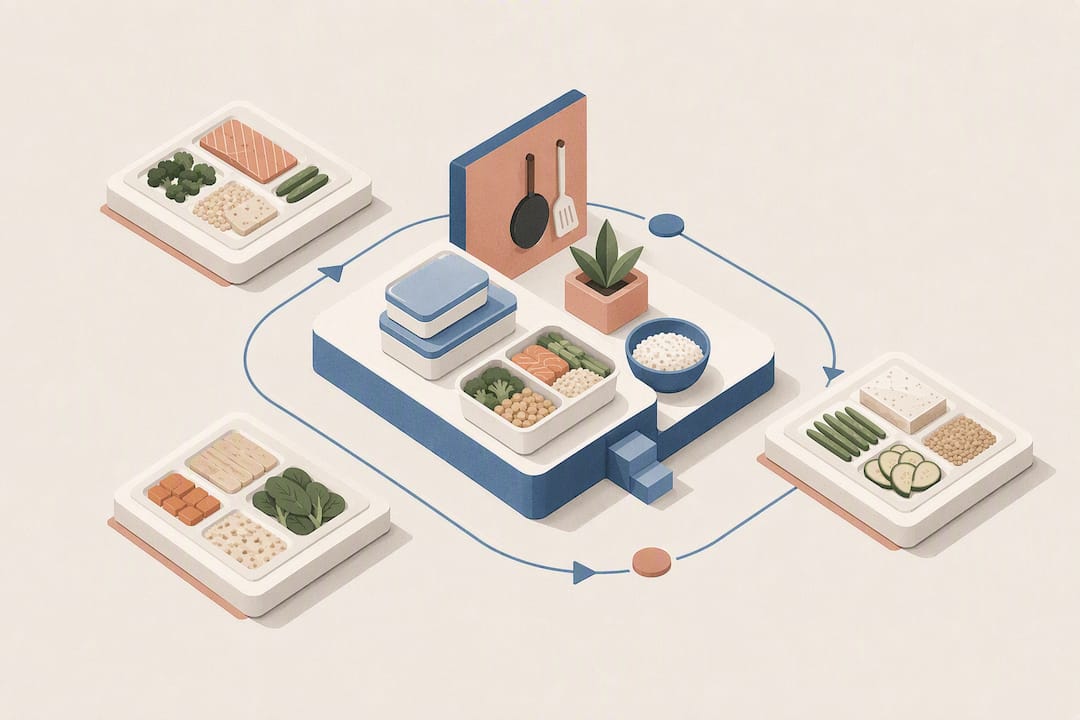
Meal prep works for weight loss when you build protein-forward, balanced plates and plan short batch sessions of a few days that support a modest calorie deficit. Follow the NHS calorie-deficit guidance of roughly 600 kcal a day below your needs, aim for the Eatwell plate split of half vegetables, a quarter protein, a quarter fibre-rich carbs, and set aside 45 to 60 minutes once or twice a week to batch-cook. Start this weekend with one protein and one tray of vegetables.
TL;DR:
- Meal prep should be based on flexible components like protein, carbs, and vegetables to maintain variety and improve adherence over time.
- A 45- to 60-minute prep session, focusing on cooking in stages, is sufficient for a 3- to 4-day rotation that emphasizes food safety and freshness.
- Most cooked meals should be refrigerated and eaten within 48 hours, with rice and seafood requiring faster consumption or freezing to avoid bacteria growth.
- The ideal portion size for weight loss is around 400 to 600 calories per meal, following the NHS guideline of roughly 600 kcal deficit daily.
- Pair meal prep routines with accountability, such as small-group training, to sustain motivation and reinforce healthy habits long-term.
Forget the idea that meal prep means seven identical Tupperware boxes lined up in the fridge. A better approach uses a handful of components you can mix and match across three or four days, so lunch on Tuesday doesn’t taste exactly like lunch on Monday.
Build every meal around this simple structure: one protein anchor, one fibre-rich carbohydrate, one vegetable combo, and a sauce or condiment to stop things tasting dull. This follows the same logic behind component-based meal prep, which tends to hold up better over time than prepping fully assembled meals because you can vary flavours daily without extra cooking.
Protein anchors (pick two):
Carbohydrate options (pick two):
Vegetable combos (pick three):
Sauces (pick two): a yoghurt and lemon dressing, and a chilli soy or peanut sauce.
A realistic 3 to 4 day rotation might run like this:
For breakfast, keep it simple and repeatable: overnight oats with Greek yoghurt and berries, or scrambled eggs with spinach on wholegrain toast. Snacks that pair well with this plan include a small handful of almonds, boiled eggs, or carrot sticks with hummus. Rather than obsessing over exact grams, use your hand as a guide: a palm-sized portion of protein, a fist of carbs, and unlimited vegetables beyond that.
Most people who quit meal prep don’t quit because the food is bad. They quit because it eats their whole Sunday. A 45 to 60 minute prep session is genuinely enough if you work in the right order and stop trying to cook every single component from scratch.
Here’s a workflow that keeps things tight:
There’s a genuine trade-off between full-meal prep and component prep. Fully assembled meals save time on the day you eat them but get boring fast and can go soggy (rice absorbing sauce, for instance). Component prep takes slightly longer to assemble each day but keeps flavours varied and textures better, which matters more than people expect when adherence is the goal.
Midweek, do a quick reset rather than a full second cooking session. Freeze anything you won’t eat within 3 to 4 days, top up with a quick stir-fry or omelette using fresh veg, and use any wilting vegetables in a soup or curry rather than binning them.
Pro Tip: Cook double the vegetables you think you need. Roasted veg reheats better than almost anything else in a meal prep rotation, and having extra means a “no prep” day is just reheating leftovers, not a takeaway order.
The NHS recommends a deficit of around 600 kcal a day below what your body needs to maintain its current weight, which typically produces steady, sustainable loss of 0.5 to 1 kg a week. That’s slow by fad-diet standards, but it’s the range most likely to stick without leaving you constantly hungry or exhausted.
You don’t need a food scale and a spreadsheet to get the proportions right. The Eatwell plate model from the British Dietetic Association gives a simple visual target for every plate:
A calorie deficit of roughly 600 kcal a day is linked to losing about 0.5 to 1 kg (1 to 2 lb) per week, according to NHS guidance.
If you like precision, counting calories for a few weeks can help you learn realistic portion sizes for your own appetite and activity level. If tracking every gram feels like a chore, the palm, fist, and thumb method works fine as a substitute: a palm of protein, a fist of carbs, a thumb of fats like nuts or oil, and vegetables filling whatever’s left. Most main meals for weight loss land somewhere between 400 and 600 kcal, though this varies with your height, activity, and how much weight you have to lose.
Food safety is where a lot of otherwise good meal prep plans fall apart. UK guidance is fairly clear: most cooked meals are safest eaten within about 48 hours if kept refrigerated, and that window shrinks for certain foods.
This is exactly why a 3 to 4 day batch rotation beats prepping a full week in one go. Cooking for the whole week sounds efficient, but by day 6 or 7 you’re either eating food past its best or you’ve bought extra to compensate, which defeats the point.
Pro Tip: If you’re prepping rice-based meals, cool the rice quickly by spreading it out on a tray rather than leaving it in a covered pot, then refrigerate it within the hour. This cuts the bacterial growth window significantly.

You don’t need specialist equipment to start. A handful of containers, a decent oven tray, and a sharp knife will get you through most weeks.
Shopping list by category:
Essential kit:
To keep costs down, buy vegetables in season, use frozen veg for anything you’re roasting or blending into soup, choose tinned beans and lentils over fresh where protein is concerned, and buy grains like rice and oats in bulk bags rather than small boxes. As the team at humn point out, a little forward planning on shopping saves both money and midweek panic trips to the shop.
Boredom, not lack of willpower, is usually what ends a meal prep habit. The fix is rarely a whole new meal plan. It’s usually a five-minute tweak.
Pro Tip: Keep one “emergency” frozen meal on hand for the weeks that go wrong. Having a backup removes the temptation to order a takeaway when your prep runs out on day three.
Meal prep rarely fails because of the recipes. It often fails because there’s no check-in when motivation dips around week three. Our small-group personal training sessions pair practical nutrition coaching with the kind of accountability that keeps a Sunday prep habit alive past January, something our group training approach is built around.
Members combine structured training with straightforward nutrition guidance rather than restrictive dieting. If you take one thing from this article, make it this: prep one protein and one tray of vegetables this Sunday. That’s the whole habit, before anything else gets added.
A weight-loss meal prep plan built purely around protein and carbs can quietly miss out on micronutrients, especially if the same three vegetables show up every week. Variety matters here as much as portion control.
Rotate vegetable colours rather than sticking to one green vegetable on repeat. Dark leafy greens like spinach and kale bring iron and folate; orange vegetables like carrots and sweet potato bring beta-carotene; peppers and citrus fruit add vitamin C, which also helps with iron absorption from plant sources. If your protein rotation leans heavily on chicken and plant proteins, include oily fish like salmon or mackerel once or twice a week for vitamin D and omega-3s, both of which are easy to underrate when you’re focused mainly on calories.

Calcium is another one that slips through the cracks on a weight-loss plan, particularly if you’re cutting dairy to save calories. Fortified plant milks, yoghurt, and tinned fish with bones (like sardines) are easy additions to a batch-cooked week. Iron deserves particular attention if your protein anchors are mostly plant-based. Pairing lentils or beans with a vitamin C source, like lemon juice or peppers in the same meal, meaningfully improves how much iron your body actually absorbs.
None of this needs supplements or a separate shopping trip. It just means treating your vegetable and protein choices as a rotation rather than a fixed formula, so the same three ingredients don’t dominate every single meal you prep.
Water gets forgotten in most meal prep plans, yet it directly affects how well a calorie deficit feels day to day. Mild dehydration is often mistaken for hunger, which can push people to snack when what they actually needed was a glass of water.
A practical habit is to prep your hydration the same way you prep your food. Keep a refillable bottle visible on your desk or in your bag, and treat topping it up as part of the same routine as reheating lunch. Water should be your default drink through the day; it has no calories and supports digestion, which matters when you’re eating more fibre than usual from all those vegetables.
Unsweetened tea and coffee fit into a weight-loss plan without much issue for most people, but be honest about what goes into them. A few teaspoons of sugar and a splash of syrup across two or three coffees a day adds up to real calories that don’t touch your hunger at all. Fruit juice and flavoured fizzy drinks are worth limiting for the same reason: it’s easy to drink several hundred calories without feeling any fuller for it.
If plain water feels dull, batch-prep a jug of water with sliced cucumber, mint, or citrus alongside your meals. It costs nothing extra and takes the same five minutes as portioning your sauces.

The biggest myth about meal prep for weight loss is that it has to be rigid to work. It doesn’t. The research on sustainable habits consistently points the other way: small, repeatable changes outperform strict overhauls, and a meal prep routine that bends a bit is one you’ll actually keep doing in March, not just in January.
Where conventional advice often goes wrong is treating meal prep as a diet in itself, when it’s really a logistics fix. It removes the moment of weakness at 6pm when you’re tired and the takeaway app is right there. That’s the actual value, not perfection on a plate.
If you take one priority from everything above, make it the 3 to 4 day rotation over the full week. It respects food safety, keeps meals fresher, and it’s far easier to sustain than a Sunday spent cooking for seven days straight. Pair that with a protein source at every meal, since protein alongside resistance training helps preserve muscle during a deficit far better than cutting calories alone.
— Vitalij
Meal prep gets you halfway there. The other half is having someone notice when you skip your Sunday session three weeks running, which is exactly where most solo weight-loss plans quietly fall apart. Some gyms run small-group personal training designed to provide structured sessions and nutrition coaching with a focus on personal accountability.

Small-group PT works well alongside a meal prep routine because the accountability cuts both ways. Your training sessions give you a reason to fuel properly, and your meal prep gives your training the energy it needs to actually progress. If you’d rather have that structure than figure it all out alone, our Small Group PT page has full details on how sessions work and how to get started. Whether it’s worth the investment for your situation is a fair question, and one we’ve answered honestly in our piece on evaluating the cost and value of small group training. Book a session and see how it fits around the routine you’ve just built.
The calorie and portion guidance in this article draws on NHS advice on calorie counting and the NHS weight-loss hub, which set the safe deficit targets used throughout. The plate proportions come from the British Dietetic Association’s weight-loss guidance, and the food-safety timings are based on UK-focused reporting on leftover safety. Check these directly if you want the full detail behind any figure used here.
This article is general information, not a substitute for advice from a qualified doctor. Consult a qualified healthcare professional about your own circumstances before acting on anything here.
Yes. It removes the decision fatigue that leads to impulse takeaways or oversized portions, and it makes it far easier to stick to a modest calorie deficit day after day.
There’s no single official definition of a “3-3-3 rule” in UK dietetic guidance. In practice, most people use a similar principle: 3 protein anchors, 3 vegetable combos, and a 3 to 4 day prep rotation, which mirrors the mix-and-match approach covered above.
Focus on protein anchors (chicken, tofu, beans), fibre-rich carbohydrates (brown rice, sweet potato), and at least two vegetable combos, following the Eatwell plate split of roughly half vegetables, a quarter protein, a quarter carbs.
Most cooked meals are safest eaten within about 48 hours when refrigerated promptly, and cooked rice should generally be used within 24 hours unless frozen straight away, according to UK food-safety guidance.
Small-group personal training adds a layer of accountability that solo meal prep plans often lack, which is the core idea behind UNIT Health & Performance’s approach of pairing structured training with nutrition coaching.