
Do two targeted strength sessions per week that prioritise squats, hinges, lunges, and single-leg stability work. That’s the evidence-backed default for most runners, adjustable between one and four sessions depending on your training phase. Schedule strength around your hard running days rather than against them, and you’ll build resilience without stealing energy from the runs that matter most.
TL;DR:
- Most runners should do two targeted strength sessions weekly, focusing on squats, hinges, lunges, and single-leg stability work, scheduled around hard running days.
- Strength training improves running efficiency, reduces injury risk through connective tissue strengthening, and enhances neuromuscular coordination, with gains visible within 8 to 16 weeks.
- Training should follow a progressive cycle of hypertrophy, strength, and power phases over three to four months, with load increases based on control and recovery signals.
- Consistency in session frequency is more effective than intensity, as two sessions per week steady over months outperforms sporadic, intense routines.
- Proper warm-up includes dynamic movements targeting the muscles used, static stretching after workouts, and careful attention to nutrition and recovery to support adaptations.
Strength training changes how efficiently you run, not just how much weight you can lift. Systematic reviews and physiotherapy guidance show resistance training improves running economy and may reduce running-related injuries when the work is progressive and focused on the lower body.
The gains show up in three distinct ways:
Reviews combining strength training with plyometric drills report improvements in running economy of roughly 4 to 6% over several weeks, which is a meaningful shift for anyone chasing a personal best. Heavy, controlled lifting also improves bone mineral density, something most running-only training never touches.
Two sessions a week is the practical sweet spot for most runners, according to coaching consensus reported by Runner’s World. That frequency delivers enough stimulus to build strength without eating into recovery. Adjust it by phase and experience level.
The scheduling rule that matters most: pair hard with hard. Doing strength work on the same day as a hard run or a long run preserves your genuinely easy days for actual recovery. If you have to split sessions across the same day, separate them by three to six hours and give priority to whichever session drives that day’s main goal. Lifting heavy the morning after a hard interval session, then trying to run easy that evening, is how people end up permanently tired rather than progressively stronger.
Seven movement patterns form the backbone of any run-specific strength plan, according to guidance from RunnersNeed. Isolated muscle work, the kind you’d see in a typical bodybuilding split, does little for running performance. These patterns do:
To regress any of these, drop the load and use bodyweight or resistance bands, and slow the tempo down so control comes before speed. To progress, add dumbbells or a barbell, increase range of motion, or slow the lowering phase to two or three seconds.
Pro Tip: Start every new exercise with two sets of eight before you even think about adding a third set or extra weight. Movement quality has to come first, especially on single-leg work where fatigue shows up as wobble, not just tiredness.
A running strength plan should match where you are, not where you’d like to be in six months. Here are three templates that scale from maintenance to race preparation.
The common thread across all three: the exercises barely change. What changes is load, volume, and how close you push to your running fitness.
Strength gains follow a phase structure, and skipping straight to heavy lifting is where most self-coached runners go wrong. A typical block runs hypertrophy, then strength, then power, expecting adaptation to a new routine to take three to six weeks.
Increase load in small, regular increments, not big jumps, and watch two signals: soreness that lingers past 48 hours, and any drop in your run quality the day after lifting. Both are your cue to hold the load steady rather than push on. Introduce plyometrics only once you can squat and hinge with good control, and dose them sparingly, as explained in this practical guide for athletes. Two sets of six to eight jumps is plenty to start.
The two mistakes that derail most runners are loading up too fast and skipping single-leg work altogether. Running is a series of single-leg landings, and training only bilateral movements like the barbell squat leaves the stabilising muscles undertrained.
Pro Tip: If a session leaves you unable to run at your normal easy pace two days later, the load was too high for where you are right now. Scale it back before your next session, not after a second one makes it worse.
At UNIT Health & Performance, small group personal training turns these templates into coached, tracked sessions rather than guesswork. Members work through the same squat, hinge, lunge, and single-leg patterns described above, with load and progression adjusted individually within the group. Many members have completed numerous workouts through this model. The youth athlete programme applies the same principles to younger runners, layering in speed and agility work. Book a session and expect a movement assessment first, then a plan built around your actual running schedule.
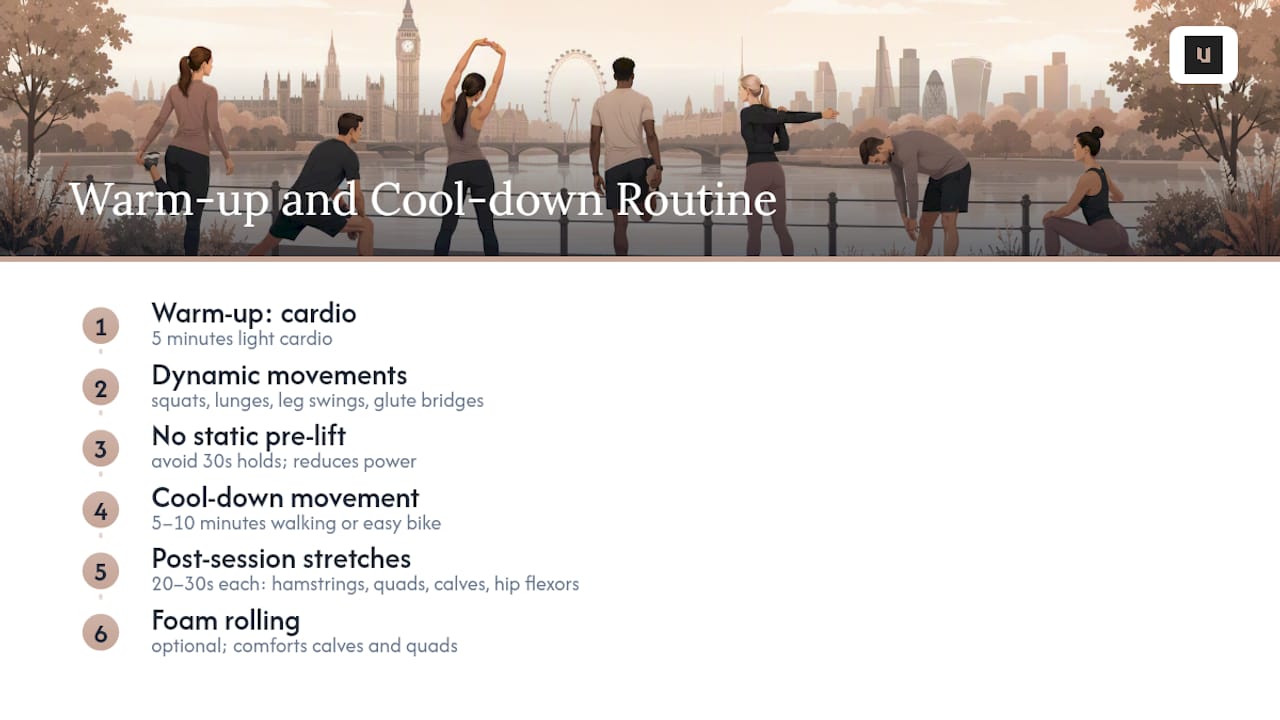
A proper warm-up for a strength session looks different from a running warm-up, because you’re preparing joints for load, not just raising your heart rate. Spend five minutes on light cardio, then run through dynamic movements that mirror what you’re about to lift: bodyweight squats, walking lunges, leg swings, and glute bridges. This wakes up the exact muscles the session targets rather than generic stretching that does little for strength work specifically.
Skip static stretching before lifting. Holding a stretch for 30 seconds can temporarily reduce the power your muscles can produce, which works against you right before a set of squats. Save static stretching for afterwards.
The cool-down matters more than most runners give it credit for, particularly after a heavier session. Five to ten minutes of gentle movement, walking or an easy bike, helps clear some of the metabolic waste that builds up during lifting. Follow that with static stretches held for 20 to 30 seconds on the muscles you worked hardest, typically hamstrings, quads, calves, and hip flexors for a lower-body session.
Foam rolling afterwards can ease tightness, particularly through the calves and quads, though it’s a comfort measure rather than a performance one. The bigger lever is simply not skipping the cool-down when you’re tired and want to leave. That five minutes is often the difference between feeling ready to run the next day and feeling stiff through a session you’d otherwise have handled fine.
Strength training adds a second demand on your body alongside running, and under-fuelling either one shows up in your recovery. Protein intake matters most here: aim for roughly 1.6 to 2.2 grams per kilogram of bodyweight daily, spread across meals rather than loaded into one sitting, to support the muscle repair that follows resistance sessions.
Carbohydrate needs don’t disappear because you’re lifting instead of running that day. Your muscles still need glycogen to fuel the session and refill afterwards, particularly if strength training sits on the same day as a hard run. A meal with carbohydrate and protein within a couple of hours of finishing supports recovery for both the lifting and the running you’re layering on top.
Hydration and micronutrients matter more than most runners assume, especially calcium and vitamin D, given the role strength training plays in building bone density. Runners who restrict calories to manage weight often see the smallest strength gains for the effort they put in, because there isn’t enough surplus energy for tissue to adapt. If you’re building strength and running volume at the same time, that’s not the phase to also be running a calorie deficit.
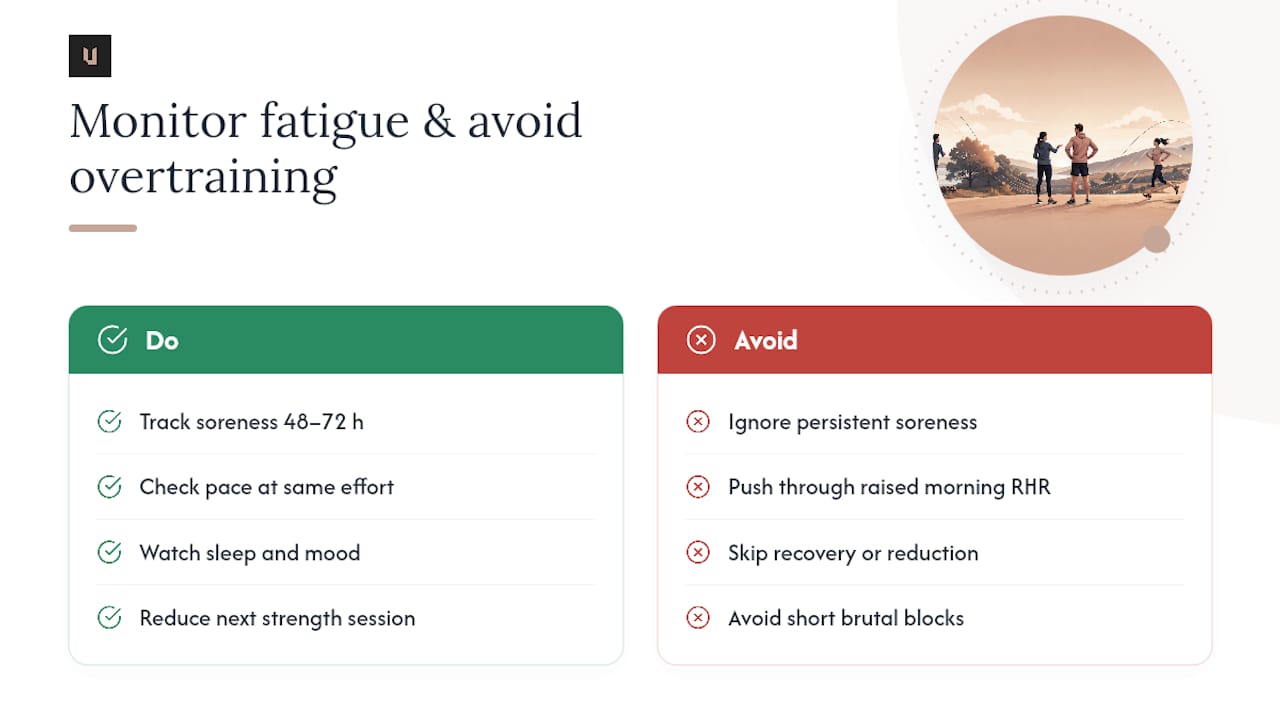
Combining strength and running increases total training load, and the warning signs of doing too much show up before an injury does, if you know where to look. Persistent muscle soreness that doesn’t ease within 48 to 72 hours is the clearest early flag, particularly if it’s still there when your next session starts.
Watch your running pace at a given effort level. If an easy run that normally feels comfortable suddenly feels hard at the same heart rate, your body is still recovering from the last strength session and hasn’t caught up. Sleep disruption, a resting heart rate that creeps up morning after morning, and a flat mood around training you’d normally enjoy are all signals worth taking seriously rather than pushing through.
The fix is rarely dramatic. Drop one strength session for a week, or halve the volume in your next one, and see whether run quality recovers. Runners who ignore these signals for weeks at a time are the ones who eventually pick up a genuine injury rather than a bit of manageable fatigue. Consistency beats intensity here: a runner doing two moderate strength sessions every week for months will out-progress someone doing four brutal sessions for two weeks and then stopping through burnout.
The conventional advice on this topic treats strength training as an afterthought, something to bolt onto a running plan once the “real” training is done. That’s backwards. The evidence on running economy and tissue resilience suggests strength work deserves the same planning attention as your interval sessions, not a leftover slot on a tired Friday evening.
Where most runners go wrong isn’t skipping the gym entirely. It’s treating strength sessions like generic gym workouts, chasing muscle soreness or copying a bodybuilding split, instead of building sessions around the seven movement patterns that actually carry over to running. A perfectly executed set of bicep curls does nothing for your marathon time. A well-loaded single-leg RDL does.
Prioritise consistency over intensity, especially in your first few months. Two sessions a week, done every week for a full training cycle, will beat four scattered sessions crammed in whenever motivation strikes. Get the frequency right before you worry about the load on the bar.
— Vitalij
UNIT Health & Performance turns the templates in this guide into coached sessions rather than something you have to figure out alone with a phone and a YouTube video. If you’re an adult runner wanting the squats, hinges, and single-leg work properly loaded and progressed, Small Group PT is built for exactly that, with plans adjusted to your running schedule rather than a generic template. Prefer a lighter, drop-in format to maintain strength around your existing training? The fitness classes cover that. Parents of younger runners can look at the Youth Athlete Program, which applies the same movement-pattern approach alongside speed and agility work. Get in touch through UNIT Health & Performance to book a trial session and get a movement assessment before your first workout.
Two sessions a week is the practical default for most runners, rising to three or four in the off-season and dropping to one or two during race taper.
If both sessions fall on the same day, do whichever supports that day’s main goal first; otherwise separate strength and hard running by three to six hours to protect recovery.
Single-leg RDLs, Bulgarian split squats, step-ups, glute bridges, calf raises, and planks cover the seven movement patterns that transfer most directly to running.
Yes. Combined strength and plyometric training has been linked to running economy improvements of roughly 4 to 6%, which shows up as holding pace with less effort.
Expect three to six weeks before your body adapts to a new routine; visible strength and running benefits typically build over an 8 to 16 week block.
UNIT Health & Performance runs small group personal training and strength classes in Sheffield built around exactly the movement patterns and scheduling covered in this guide.