For most people, the best meal timing for strength is simple. Eat a balanced meal with protein and carbohydrate about 1 to 3 hours before you lift. Have another protein-rich meal within a few hours afterwards. Then spread your protein evenly across the day. Timing matters, but it comes second to eating enough in total and training consistently.
Below, we explain each step in plain language, with worked examples for busy days, early mornings and evening sessions.
The short answer is 1 to 4 hours, depending on how big the meal is.
The Mayo Clinic suggests large meals at least 3 to 4 hours before exercise, and small meals or snacks about 1 to 3 hours before. The British Heart Foundation says that ideally you would have a balanced meal two to three hours before working out.
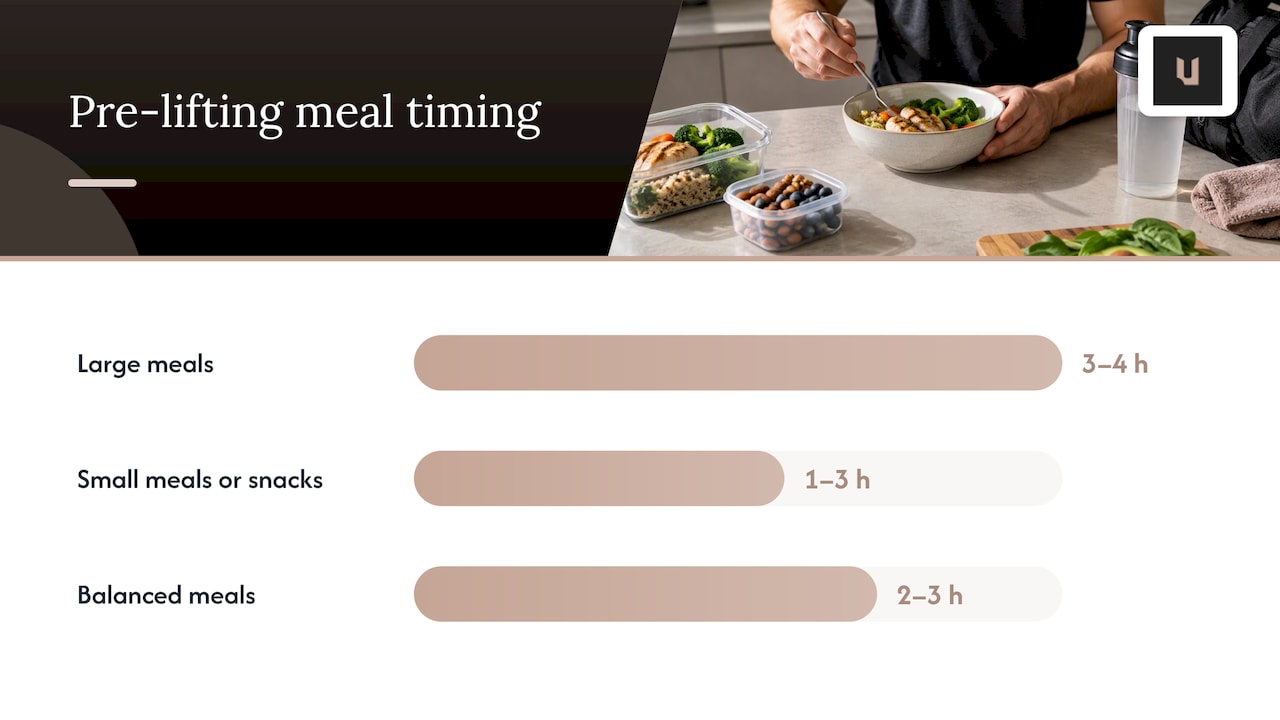
Why the gap? Food takes time to leave your stomach. Lift too soon after a big meal and you may feel heavy, bloated or sick, especially on squats, deadlifts and anything where you bend over. Lift too long after eating and you may feel flat and low on energy.
Here is a simple guide:
| Your last food | Roughly how long before lifting | Example |
|---|---|---|
| Large, full meal | 3 to 4 hours | Chicken, rice and vegetables |
| Medium balanced meal | 2 to 3 hours | Eggs on wholemeal toast with fruit |
| Small snack | 1 to 2 hours | Yoghurt and a banana |
| Very light snack, if hungry | Within 30 minutes | A banana or a slice of toast |
The table is a starting point. Your stomach is the final judge, so try a timing for a few sessions and note how you feel.
Keep it simple: some carbohydrate for energy, some protein, and not too much fat or fibre close to training, because those digest slowly.
UCLA Health says that for strength training, a balanced meal with protein and carbohydrate one to three hours before helps support energy levels. If you are within 30 minutes of training, a snack is not required, but you can have one if you are hungry.
Good pre-lifting options:
Protein before exercise can help your muscles build. The British Association of Sport and Exercise Sciences (BASES) notes that protein before exercise stimulates muscle protein synthesis, but it may be wise to avoid it right before training if it upsets your stomach. So if a big protein shake just before lifting makes you queasy, move it earlier or have it afterwards.
Not always. The BHF says you can exercise without eating beforehand if the session is low intensity or lasts under an hour. Plenty of people lift well first thing in the morning on a light snack. If you feel shaky, weak or dizzy, eat something small next time. If you have a medical condition such as diabetes, or take medication that affects blood sugar, ask your GP or a dietitian how to time food around training.
After training, your body is ready to repair and refuel. You do not need anything fancy. A normal meal with protein and carbohydrate does the job.

The BHF advises that after a long session you should have a recovery meal or snack within an hour, and that this matters most if you have not eaten for a few hours beforehand. The International Society of Sports Nutrition (ISSN) also says that carbohydrate and protein, or protein alone, around training can support strength and body composition gains.
Easy post-session meals:
If your next meal is more than an hour or so away, a snack bridges the gap. Our guide to portable high protein snacks has ideas that travel well in a gym bag.
Yes, usually. Carbohydrate refills the energy stores your muscles used, and it makes a meal easier to enjoy. You do not need to chase huge amounts. A normal portion of rice, potatoes, pasta, bread or fruit alongside your protein is plenty for most people lifting two to four times a week.
You may have heard that you must drink a shake within 30 minutes of your last rep or lose your gains. The research does not back that up as a strict rule.
A well-known review by Aragon and Schoenfeld concluded that there is no universally narrow or urgent post-exercise window. Depending on what you ate before training, your next protein-rich meal may be soon enough. The same authors say the window changes with several factors, including your pre-exercise nutrition.
In practice:
The same review suggests that meals before and after training should generally be separated by no more than about 3 to 4 hours, or up to 5 to 6 hours if the protein comes in large mixed meals. That gives you a lot of freedom. If your lunch is at 12:30, you train at 5:30 and eat dinner at 7:30, you are well covered.
Timing works best when your total intake is right. Otherwise you are fine-tuning a plan that has a hole in it.
BASES says athletes generally need 1.6 g of protein per kg of body mass per day or more, compared with the UK recommended amount of about 0.8 g/kg/day. It also reports that about 20 to 30 g of high-quality protein per meal (0.25 to 0.30 g/kg) is effective for stimulating muscle protein synthesis.
A worked example for someone weighing 80 kg:
The ISSN position stand puts the range at 20 to 40 g of high-quality protein every 3 to 4 hours, and describes evenly spaced feedings through the day as a main focus for people who exercise. So there is no need to eat every hour. Three or four protein-rich meals a day is enough for most people.
If you cook for a family, building the evening meal around protein helps everyone. These high protein family dinners show how to hit a decent per-meal amount without cooking separate dishes.
BASES points out that most of an athlete’s protein should come from whole foods such as egg, beef, salmon and whole milk. Shakes and bars are handy when you are rushed, but they work best as a top-up. If you follow a plant-based diet, mix sources such as soya, lentils, beans, tofu and grains across the day.
BASES also suggests that protein before sleep can help muscle remodelling overnight. A bowl of skyr, a glass of milk or cottage cheese on toast is an easy evening option. Pair it with good rest, which we cover in our piece on sleep and muscle recovery.
For a normal gym session of about an hour, you usually do not need to eat during it. Water is enough. For longer or very demanding sessions, the ISSN says that carbohydrate during resistance training can help maintain blood glucose, reduce muscle damage and support adaptation. A piece of fruit or a carbohydrate drink is a simple way to do that.
The best plan is the one that fits your timetable. Here are three common patterns.
You have little time and a nervous stomach at 6 am. Try a banana or slice of toast with honey 30 to 45 minutes before, or train on water if the session is light and short. Then have a proper breakfast afterwards, such as eggs, toast and fruit, or porridge with milk and a scoop of protein powder.
Have breakfast as usual, then a small snack such as yoghurt and fruit 1 to 2 hours before your session. After training, go straight to lunch. This is the easiest pattern to get right.
You are tired and hungry by 5 pm. Have a balanced lunch around 12 to 1 pm, then a snack 1 to 2 hours before training, such as a sandwich or a pot of yoghurt with oats. Eat dinner within an hour or two of finishing. If you are unsure whether mornings or evenings suit you better, our morning vs evening workouts trial helps you test it.
If you are planning your food ahead, our simple weekly meal prep plan takes a lot of the daily decision-making out of it. And before you lift, a short warm up for strength training gets your body ready.
As we get older, getting enough protein and spreading it out matters more, because muscle is harder to build and easier to lose. Our pieces on two sessions a week for over 40s and strength training over 50 show how to start. If you take a GLP-1 medication and your appetite is low, read strength training on GLP-1, and speak to your prescriber or a dietitian about how much to eat and when.
At UNIT, we see the same pattern again and again. Members arrive asking about the perfect pre-workout meal, and what they really need is a routine they can repeat. Our approach is to keep the basics simple: eat a proper meal a couple of hours before training, include protein at each meal, and refuel after.
We coach small groups, so we can see how each person responds. One member feels great on a banana before an early session. Another needs a full breakfast and a two-hour gap. That is why our training is individualised, and why we pair it with nutrition and accountability coaching. We would rather you find what works for your body and your week than copy a rule from the internet.
Food is one part of the picture, alongside good sleep, steady training and a supportive community. Get those working together and the timing details fall into place.
Vitalij
If you want help with training and food in the same place, our small group personal training in Sheffield gives you an individual plan, expert coaching and a friendly, non-intimidating group. We also offer nutrition and accountability coaching to help you build habits that last.
See how it works on our small group PT page, or explore our fitness classes if you prefer a class setting. Parents can look at our youth athlete programmes for speed, agility, strength and power.
Allow 3 to 4 hours after a large meal and about 1 to 3 hours after a small meal or snack, as the Mayo Clinic suggests. If you feel heavy or sick during squats or deadlifts, leave a longer gap. If you feel flat, eat a little closer to training.
There is no official rule by that name. People usually mean having protein within a couple of hours of training. The research shows the window is wider than that, so a protein-rich meal within a few hours, and enough protein across the whole day, is what counts.
Yes, in most cases. Carbohydrate helps refill your energy stores, and the BHF recommends a meal or snack with carbohydrate and protein within an hour after a long session. A normal portion of rice, potatoes, bread or fruit is enough.
For low-intensity or shorter sessions, the BHF says you can exercise without eating first. Stop and eat if you feel dizzy or weak. If you have diabetes or take medication that affects blood sugar, ask your GP before training fasted.