Caffeine before a workout can help you train harder, and the research behind it is strong. The benefit depends on getting three things right: a modest dose, about 30 to 60 minutes before you start, and a cut-off time that protects your sleep. Get those wrong and you can end up jittery, with a racing heart, and sleeping badly. Get them right and the same training session simply feels easier.
If you are a busy professional squeezing training around work, or you are over 40 and want to get stronger without wrecking your sleep, the details matter more than the hype. At UNIT Health & Performance in Sheffield, we coach small groups where every member follows a plan built around them. That is the right way to think about caffeine too: it is a tool you tune to your body, not a rule you copy from a tub label.
Caffeine blocks adenosine, a chemical that builds up in the brain and makes you feel tired. It also switches on your nervous system a little and makes effort feel less hard. A 2026 review of the evidence names these as the most consistent ways caffeine works: blocking adenosine, more nervous system activity and a lower sense of effort.
That last point is the one you notice in the gym. The International Society of Sports Nutrition (ISSN), a leading body in this field, reports that a meta-analysis of 21 studies found caffeine cut perceived exertion by 5.6% and improved performance by 11% on average. The same session simply feels easier, so you can push a little further.
The benefit is not the same for every type of training:
Researchers at Anglia Ruskin University summarised it this way in 2026: a dose of 3 to 6 mg per kilo can lift strength by around 7% and endurance by around 15%. Treat those as averages. Some people respond a lot, some barely at all, which is why you tune your own dose.
One more thing worth knowing: caffeine can make exercise feel less painful and tiring, but that is a change in how your brain perceives effort, not faster recovery. Feeling fresh does not mean your muscles and joints are fresh. Keep your warm-up and your technique standards the same.
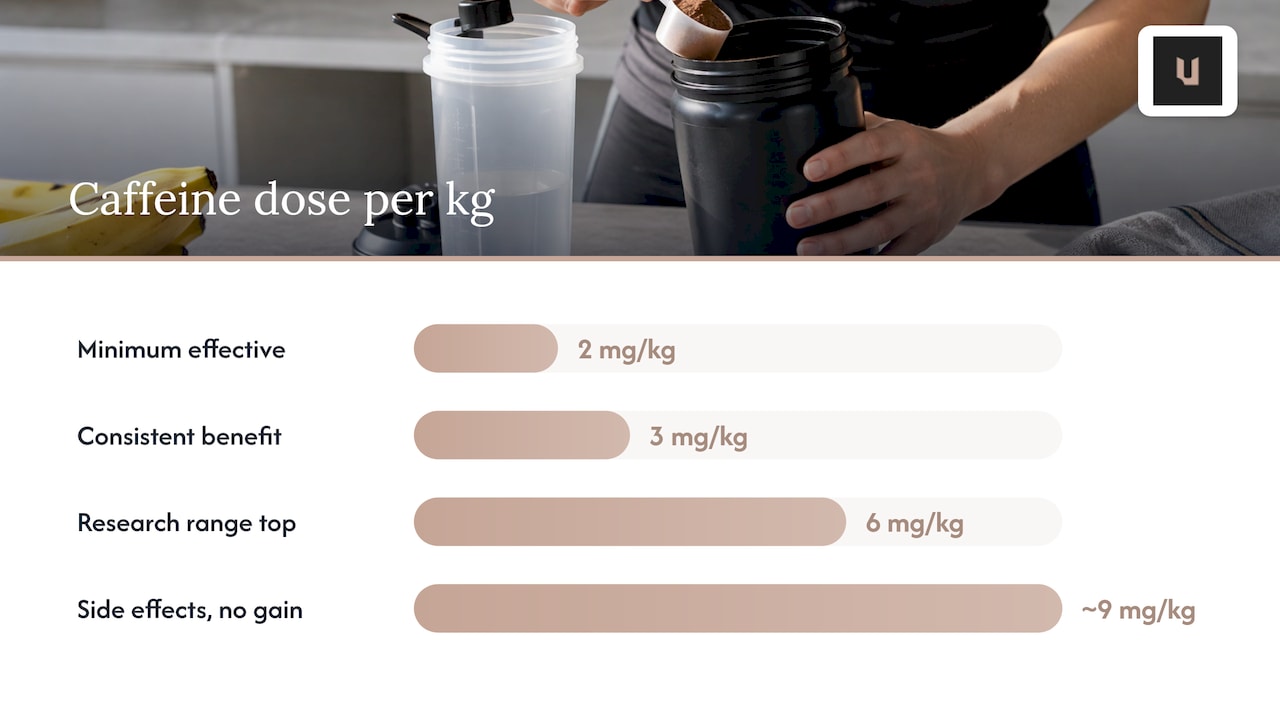
The research dose is measured in milligrams (mg) per kilogram (kg) of body weight. The ISSN says caffeine consistently improves performance at 3 to 6 mg per kilo, and that the minimum effective dose may be as low as 2 mg per kilo. Very high doses, around 9 mg per kilo, bring a high rate of side effects without extra benefit.
Here is what that looks like in real numbers for a 75 kg person:
| Dose per kilo | Caffeine for a 75 kg person | Roughly equal to |
|---|---|---|
| 2 mg/kg | 150 mg | 1 to 1.5 mugs of coffee |
| 3 mg/kg | 225 mg | About 2 mugs of coffee |
| 6 mg/kg | 450 mg | Above the daily UK guidance limit for most adults |
A mug of coffee contains about 100 to 140 mg, according to GOV.UK guidance on caffeine. Notice the bottom row. The top of the research range, 6 mg per kilo, can push a heavier person past the 400 mg a day that UK guidance treats as unlikely to cause harm in most adults. For most people in a normal gym routine, there is no reason to aim there.
The European Food Safety Authority looked at this directly. It concluded that single doses up to 200 mg do not raise safety concerns, even within two hours before intense exercise, and that up to 400 mg a day is safe for healthy, non-pregnant adults.
The smart route is to start small. Sports scientist Lawrence Spriet suggests beginning with around 100 to 200 mg, since higher doses do not seem to add an advantage, and trying it in training before you rely on it. Mayo Clinic Press gives similar advice: start with a small dose and increase gradually.
A simple way to do it:
The most common timing in studies is 60 minutes before exercise. Mayo Clinic Press suggests 30 to 60 minutes before a workout, with the boost lasting about 3 to 4 hours. The ISSN also notes that timing depends on the source: chewing gum, for example, can act faster than capsules.
That 3 to 4 hour window is the thing busy professionals overlook. A 6 pm session with a strong coffee at 5.15 pm still has caffeine working in your system at bedtime. The same Mayo Clinic Press guidance suggests cutting caffeine after 2 or 3 pm to protect sleep, and EFSA notes that 100 mg close to bedtime may make it take longer to fall asleep in some adults.

If you train in the evening, you have three sensible choices: use a smaller dose, take it earlier, or leave caffeine out and let a good meal and a proper warm-up do the work. Our article on morning versus evening workouts explains how to settle on the time that suits your body and your diary.
What you eat matters too. A light meal or snack before training gives you something to work with, and caffeine on a completely empty stomach upsets some people. Our guide to meal timing for strength covers what to eat and when.
Coffee works. The BJSM review reports that coffee providing 5 mg per kilo was as effective as caffeine powder for endurance, and gives a rule of thumb: two cups of coffee, about 200 mg, around 60 minutes before exercise should help most people.
The catch with coffee is that the caffeine content varies a lot with the bean, how it is brewed and the size of the cup. A large takeaway latte and a small espresso are not the same dose. If you want to keep your dose steady, use the same drink in the same size each time.
What about pre-workout powders? The Anglia Ruskin researchers found that supplements generally do not outperform the same dose of caffeine alone, which suggests caffeine is doing most of the work. So you are not missing anything by choosing a simple coffee. If you do like tablets, gum or powders for convenience, it helps to see what is on offer, and comparing vitamins and supplements deals shows the range of forms available.
If you do use a supplement, read the label for the milligrams per serving. The Food Standards Agency and Food Standards Scotland issued guidance in September 2024 after a man died from a miscalculated dose of caffeine powder. Food Standards Scotland’s policy head said that pure caffeine powder is particularly potent and that people should follow label instructions with precise measuring tools. GOV.UK advises avoiding supplements with more than 200 mg of caffeine in a single serving, and counting caffeine from coffee, tea, chocolate and energy drinks together.
A little, and mostly during the session itself. A 2024 review reports that a meta-analysis found caffeine at 2 to 7 mg per kilo increased fat burning during exercise, with larger effects in sedentary or untrained people. Findings on long-term weight loss are mixed.
So the honest answer is that caffeine is a helpful add-on, not a fat loss plan. The things that change your body shape over months are a progressive strength programme, enough protein, good sleep and sessions you actually turn up to. If your goal is to get leaner, caffeine can make a session feel easier, and that matters mostly because it helps you train consistently.
Caffeine is safe for most healthy adults at sensible doses. The cautions below are the ones that matter.
GOV.UK guidance says high caffeine intake can cause anxiety, sleeplessness, agitation, palpitations, diarrhoea and restlessness. Those effects are stronger, and can appear at lower doses, in people who are sensitive to caffeine, and in people with heart disease or high blood pressure. It can also worsen psychosis in people with mental health conditions.
Take particular care, and speak to your GP first, if:
Parents of young athletes should also know that these figures are for adults. Children and teenagers should not be given pre-workout products. A good breakfast, water and a full night’s sleep do far more for a young athlete’s training.
Signs you have taken too much are a racing heart, shaking, stomach upset, feeling anxious or a headache. Stop, drink water, and cut your dose next time. If you have chest pain, a very fast or irregular heartbeat, or feel faint, get medical help straight away.
Also drink enough water around training. Caffeine is not a reason to skip fluids, and our guide to hydration for workouts shows how much to replace after a session.
Most caffeine studies were done on young, fit men. The BJSM review points this out and calls for more research in women and in middle-aged and older adults. EFSA likewise found no studies of a single dose before intense exercise in middle-aged or elderly people.
That does not mean caffeine is off the table. It means you should treat your own response as the evidence. The ISSN authors conclude that a case-by-case approach is warranted, weighing the benefit against the risk of side effects, given that genetics and your usual intake change how you respond.
In practice, if you are over 40:
If you do both strength and cardio in one session, order matters more than any drink. Our article on lifting before cardio explains why.
On days when you feel well rested and motivated, skip it. Caffeine works best as a tool you choose, not a habit you need to get through a session.
Caffeine is one small piece of a much bigger picture. If you want to get stronger, leaner and fitter, what moves the needle is a plan built for you, someone watching your technique, and a group that keeps you turning up.
At UNIT Health & Performance in Sheffield, we run small group personal training for people over 40, with individualised plans and expert trainers who make sure every session has a purpose. Members can also join our unlimited fitness classes, and we offer nutrition and accountability coaching alongside the training. Our setting is a supportive, non-intimidating community, so you can work on strength, fitness and weight without feeling out of place. If you are a busy professional in Sheffield, it is a way to make the hours you have count.
If you would like to see how it works for you, start on the UNIT Health & Performance home page and get in touch.
We see caffeine the way we see most things in training: useful when it is used with a purpose, and never a replacement for the basics.
The research is clear that a modest dose can make hard sessions feel easier. It is equally clear that people respond differently. That is exactly why we believe in individualised coaching. A plan, a dose and a bedtime that suit one member will not suit the next, and the evidence says as much.
For our members, especially those over 40 who are balancing work, family and recovery, we put sleep, strength work, food and consistency first. Those are the things that give you results you can keep for years. If a coffee before a session helps you walk through the door and train with intent, that is fine. If it leaves you wired at 11 pm, the plan has failed, and we would rather you changed it.
Our aim is sustainable health and performance: stronger, leaner, fitter, with longevity in mind. A small group where a coach knows you by name, knows your goals and adjusts your sessions is the best way we know to get there.
Vitalij
For most healthy adults, yes. The ISSN position stand reports that caffeine acutely improves several aspects of exercise performance, with the clearest benefit for endurance. Keep to a modest dose and watch your sleep. If you have a heart condition, high blood pressure or anxiety, check with your GP first.
About 30 to 60 minutes before. The effect lasts roughly 3 to 4 hours, so for an evening session consider a smaller dose or an earlier drink to protect your sleep.
Caffeine can raise fat burning during exercise, but evidence for long-term weight loss is mixed, and you cannot choose where fat comes off. Lasting change comes from regular strength training, enough protein, good sleep and steady habits. Caffeine can help you feel better during sessions, which helps you keep going.
Caffeine can briefly raise stress hormones in some people, which is part of why it can feel jittery at high doses. At modest doses, taken well before bedtime, most healthy adults tolerate it well. If you notice anxiety, a racing heart or poor sleep, lower the dose or move it earlier in the day.