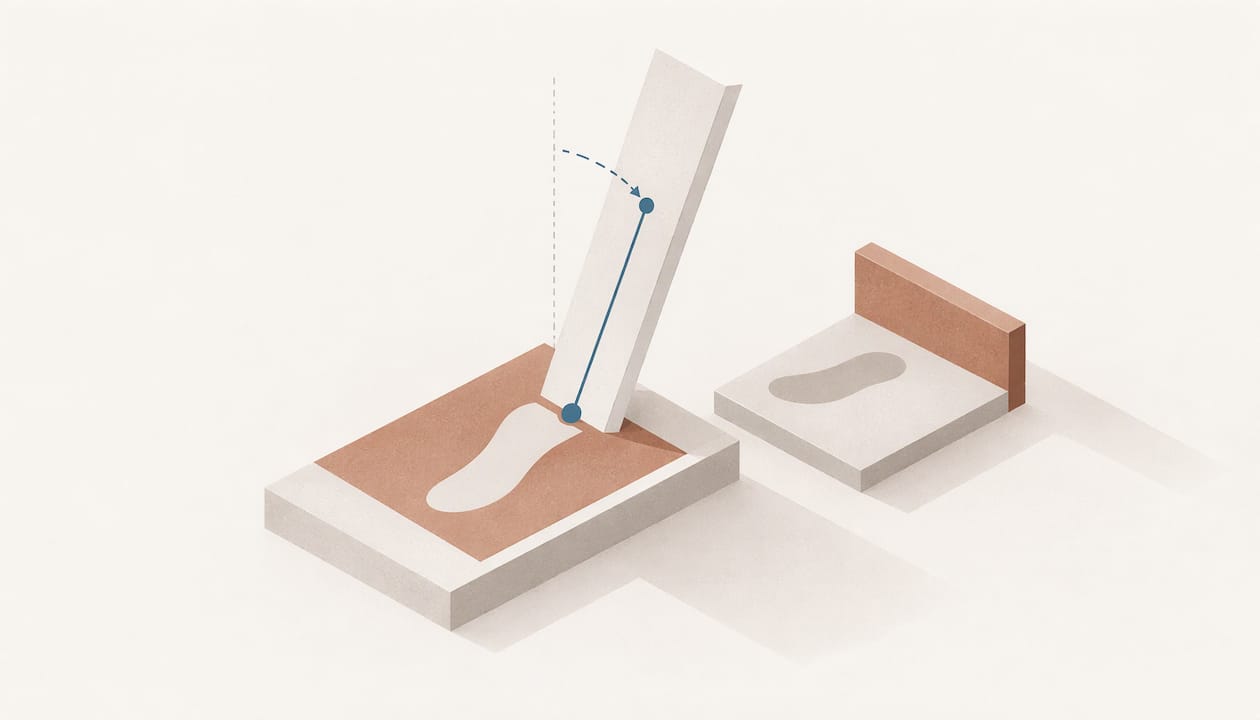
Dynamic stretching means moving your joints through their range, and it belongs before you train. Static stretching means holding a position, and it fits best after training or as its own session. Short holds before lifting are fine. Long holds right before heavy or fast work can leave you a little weaker. This guide explains the difference in plain words, shows what the research says, and gives you a warm-up to use in your next session.
Both types of stretching lengthen muscles and move joints. The difference is whether you are moving or holding.
Dynamic stretching uses controlled movement. You swing, step, rotate or reach, and each rep takes the joint a little further toward its limit. Physiotherapists describe it as a series of movements that work more than one muscle at a time. Think walking lunges, arm circles, leg swings and hip openers.
Static stretching is the classic stretch. You reach as far as is comfortable in one direction and stay there. Holds are usually quoted at 15 to 60 seconds. Think of a standing quad stretch, a hamstring stretch with your foot on a step, or a doorway chest stretch.
A quick way to tell them apart: if you are still moving, it is dynamic. If you are still, it is static.
| Dynamic stretching | Static stretching | |
|---|---|---|
| What you do | Move through a range, again and again | Hold one position |
| Typical time | 5 to 10 minutes in total | 15 to 60 seconds per stretch |
| Best time to use it | Before training | After training, or a separate session |
| Main aim | Warm up, rehearse the movement | Improve flexibility, relax |
| Examples | Leg swings, inchworms, lunges with a twist | Hamstring hold, quad hold, chest stretch |
If you want to go deeper on the related idea of mobility, our guide to flexibility vs mobility explains how the two differ and which one you may need more.
A warm-up has a few jobs. It raises your heart rate and body temperature, takes your joints through the positions you are about to use, and gets your muscles and brain ready to work together. Dynamic stretching does all of that at once, because it looks like the exercise you are about to do.
The research backs this up. A 2023 review and network meta-analysis pooled many trials on stretching and athletic performance. It found that dynamic stretching on its own, and dynamic combined with static, were both better than no stretching for countermovement jump height. It also found that static stretching alone had a small negative effect on sprint time.
A 2025 review of stretching methods found that dynamic stretching improves maximum range of motion without hurting strength. So you get the movement benefit without paying for it in the weights room.
This is why the usual advice for lifting is simple: start with a few minutes of easy cardio, then do dynamic movements that match your session. If you are squatting, think hips, knees and ankles. If you are pressing, think shoulders, upper back and wrists.
Our 10-minute warm-up for strength training puts this into a full routine you can follow.
This is where the “dynamic vs static” debate gets practical. The issue is not that static stretching is bad. The issue is how long you hold, and when.
Researchers call it the stretch-induced force deficit: a short-term dip in how hard a muscle can contract after it has been held in a long stretch. The size of the dip depends mainly on duration.
| Hold time per muscle | What the research found |
|---|---|
| Under 30 seconds | No harmful effect on maximal strength in a 2012 systematic review (pooled change of about 1%) |
| 30 to 45 seconds | Same review: no significant effect (about 2% pooled change) |
| Up to 60 seconds | A 2019 review found a trivial impact on later strength and power, around 1 to 2% |
| Over 60 seconds | The same 2019 review found clear drops of roughly 4 to 7.5% |
A 2024 meta-analysis of 83 studies and 2,012 participants agrees. It found a small overall loss of maximal strength after static stretching, and a much larger one when single holds lasted 60 seconds or more.
In 2025, a panel of international experts published practical recommendations on stretching. They advise against holding a stretch for more than 60 seconds per muscle before maximal or explosive efforts. They also note that short static stretches inside a dynamic warm-up, and dynamic stretching itself, do not cause these dips.
So what does this mean for your session?
There is a useful extra detail. The 2019 review also found that short static stretches within a full warm-up may help lower the risk of muscle and tendon injuries in high-intensity work such as sprinting and quick changes of direction. So short holds can have a place in your warm-up, as long as they are part of the whole routine and not the whole routine.
If you want to read more on how flexibility and injury risk link up, this overview of flexibility and injury research is a good next step.

None of the above means you should stop static stretching. It simply has a different job.
After training. Your muscles are warm, and holding a stretch gives you a calm way to bring your breathing and heart rate down. It also gives you a few quiet minutes to notice what felt tight in the session.

To build flexibility over time. The 2025 review mentioned above found that long-term stretching programmes improve flexibility without harming strength. It also noted that static stretching sustained for at least eight weeks may even bring small strength gains. So a regular routine of holds, done on its own or after training, is a sound plan if flexibility is your goal.
On rest days or in the evening. A 10-minute stretch session while you watch TV counts. For people who sit all day, this is often the most realistic way to get stretching done.
If a stretch causes pain, or you are coming back from an injury, speak to a physiotherapist or your GP before pushing through it.
For most people, 5 to 10 minutes is the sweet spot. The 2023 network meta-analysis found that 7 to 10 minutes of dynamic stretching gave the best explosive performance. The authors suggest that shorter spells do not use the tendon’s stretch response well, while longer ones can start to tire you out.
That fits what most coaches do in practice. Spend a couple of minutes raising your heart rate with a brisk walk, light jog or easy bike. Then spend the rest on movements that suit the session. Nottinghamshire Fire and Rescue Service gives similar advice in its firefighter fitness guidance: five minutes of light cardio, then mobilising and dynamic work such as arm circles, torso rotations, squats, hip openers, knee lifts and heel kicks.
For older beginners and people who feel stiff in the morning, the full 10 minutes is a good place to start. You will likely find you move better by the time the first working set arrives.
Here is a routine you can do in about eight minutes. Adjust it to the lifts you plan to do.
Nike’s UK training guide offers a similar sample routine with squat-to-stands, the world’s greatest stretch, leg swings and inchworms, which shows how widely this style of warm-up is used.
The last step matters most. Practice sets with lighter weights are the best way to rehearse your exact technique. If you use a foam roller, keep it short: our guide to foam rolling before a workout covers the 30 to 60 seconds per area that suits most athletes.
People who search for stretching before lifting often also ask about tempo, so here is the short version.
Tempo is how fast you move through each part of a rep. It is often written as four numbers. For example, a 3/1/1/0 squat would mean three seconds lowering, one second pausing at the bottom, one second lifting, and no pause at the top. The first number is the lowering phase, the second is the pause, the third is the lifting phase and the fourth is the pause at the top. An “X” means as fast as you can.
What does the research say?
The practical takeaway: you do not need to chase a perfect tempo. Control the weight, lower it for a couple of seconds, and lift with intent. Use slower tempos when you want to practise technique or work with lighter loads, and keep the lifting phase quick when power matters.
Tempo and stretching also link up in the warm-up. Slow, controlled lowering reps with light weights act as a warm-up for the exact movement, which is why practice sets are so helpful.
Cat-cow is dynamic. You alternate between arching and rounding your spine, and you do not hold either position. It works well as a gentle part of a warm-up, especially for the back, or as a way to loosen up first thing in the morning. Do 8 to 10 slow reps, moving with your breath.
At Unit, most of the people we coach are over 40, and many are busy professionals who come in straight from a desk. They are not training to win medals. They want to get stronger, leaner and fitter, and keep doing it for decades.
That is why we treat the warm-up as part of the session and not a box to tick. A few minutes of purposeful, dynamic movement shows us how someone feels that day, and it prepares the joints they are about to use. In small group personal training, each member’s plan is built around their needs, so the warm-up changes too: a different hip routine for one person, extra shoulder work for another.
We keep static stretching for the end, when there is time to breathe and let the body settle. It is a good habit, and members often say it helps them leave feeling better than when they arrived.
Our approach is built on sustainable results and longevity, not quick fixes. A good warm-up, sensible lifting, and a supportive group around you are the things that keep you training week after week.
Vitalij
If you would rather not work out your own warm-up, we can do it with you. Our small group personal training in Sheffield gives you an individual plan, coaching in every session and a friendly, non-intimidating community.

We also run fitness classes, including Conditioning and Hybrid for adults, and speed, agility, strength and power programmes for young athletes through our youth athlete programme. Get in touch through our website and we will help you pick the right fit.
Do dynamic stretching before a workout. It raises your heart rate and prepares the joints and muscles for the movements you are about to do. If you want to include a static stretch, keep it short, around 15 to 30 seconds, and place it inside a longer dynamic warm-up.
Yes, in short doses. Research shows that holds under about 60 seconds per muscle have only a trivial effect on later strength and power. Long holds of 60 seconds or more are the ones linked with clear drops, so leave those until after your session.
Aim for 5 to 10 minutes in total. A 2023 meta-analysis found that 7 to 10 minutes gave the best explosive performance. Begin with a few minutes of light cardio, then move on to dynamic exercises that match your workout.
No. It is a good way to cool down and, done regularly over weeks, to improve your flexibility. Reviews show that long-term stretching programmes build flexibility without harming strength. It simply works better after training than before heavy or explosive work.
Not really. For a warm-up, lift lighter weights with good control and a smooth, steady pace. Tempo becomes more useful in your working sets, where a two-second lowering phase and a quick, controlled lift is a simple default.