
If you can commit to two or three sessions a week, full body training usually gives you better consistency and frequency per muscle group. If you reliably train four or more days, a split lets you pile more volume onto each muscle without marathon sessions. The real driver, according to the 2024 meta-analysis, is weekly volume, not the split itself: match your total sets to your schedule and either approach works.
TL;DR:
- A 2024 review of 14 studies involving 392 participants found no significant strength or muscle growth difference when routines matched weekly volume.
- Aim for about 10 weekly sets per muscle group; distribute them across two or three full body sessions, or concentrate them into split sessions.
- In a trial lasting eight weeks, trained men on full body training lost 0.775 kilograms of fat, while split trainees gained 0.317 kilograms.
- Because the fat loss trial involved trained men for only eight weeks, treat its result as suggestive rather than universal.
- When poor sleep or high life stress limits recovery, lower training frequency and allow more rest between sessions, regardless of your chosen routine.
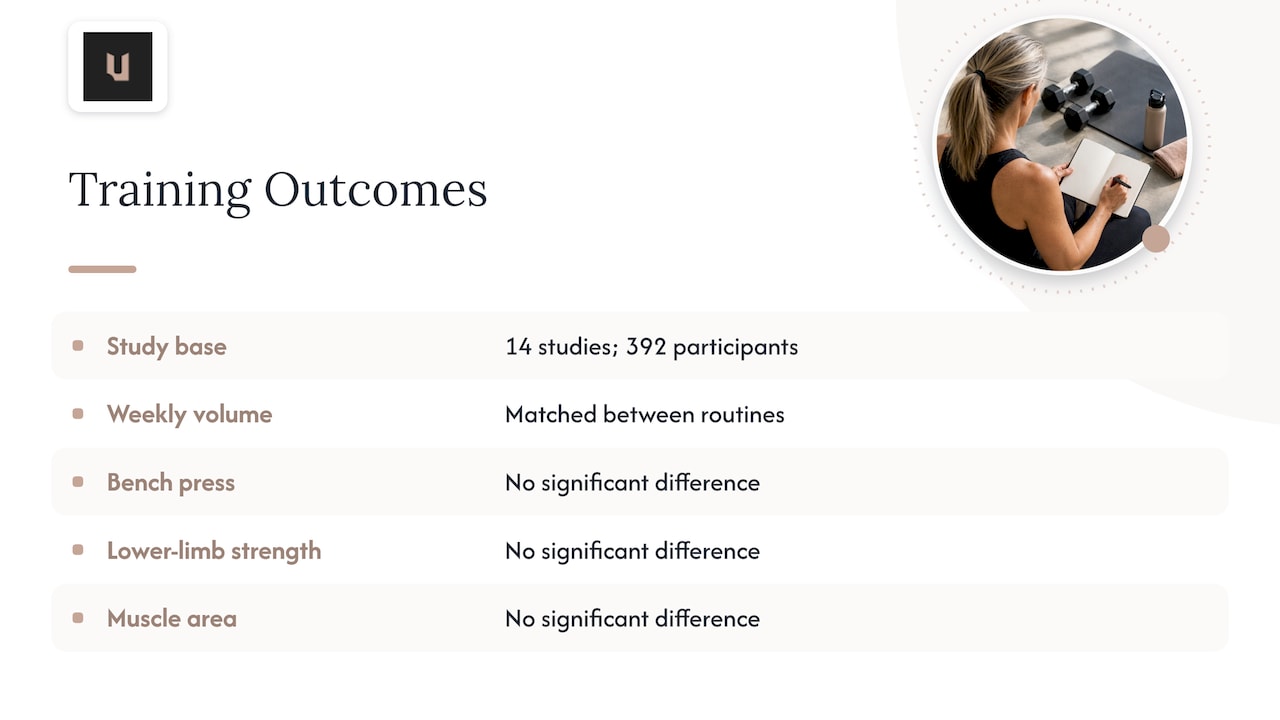
For years, gym folklore insisted that splits built more muscle because you could “destroy” one muscle group at a time. The research does not back that up. A systematic review and meta-analysis from 2024 pooled 14 studies and 392 participants and found no significant difference in strength or hypertrophy between full body and split routines when weekly training volume was matched. Bench press strength gains, lower-limb strength and muscle cross-sectional area all came out statistically even, with p-values ranging from 0.29 to 0.93.
The headline figure: when volume is equated between routines, split training shows no measurable strength or hypertrophy advantage over full body training, a finding drawn from 392 participants across 14 trials.
A separate randomised trial looked at fat loss specifically and found an edge for full body training. Over eight weeks, well-trained men following a full body programme lost 0.775 kilograms of whole-body fat mass on average, while the split group gained 0.317 kilograms. The full body group also completed roughly 16% more total training volume across the intervention and reported lower muscle soreness, which likely let them train harder and more consistently.
Both studies come with caveats worth keeping in mind. The samples were modest, the fat-loss trial used well-trained males over just eight weeks, and most resistance training research runs short, often four to twelve weeks, which limits what it tells us about year-long progress. Still, the pattern is consistent: when you control for volume, the split itself matters less than whether you actually do the work.
Volume, not split, is the variable doing most of the work. If two routines deliver the same number of hard sets per muscle group each week, they tend to produce similar outcomes, which is exactly why the meta-analysis found no real difference between approaches. The split just decides how those sets get distributed across your week.
An umbrella review of resistance training research concluded that around 10 sets per week per muscle group is a practical target for hypertrophy, alongside advice to favour a moderate eccentric emphasis and avoid very slow repetitions. A Bayesian network meta-analysis ranked higher-load, multiset training performed three times weekly as the best approach for strength, while twice-weekly multiset training ranked highly for hypertrophy.
Practically, that gives you a few ways to hit your numbers:
Frequency becomes more useful when recovery is the bottleneck: spreading sets across more sessions eases the load per workout. Concentrated, less frequent sessions work fine when you recover quickly and can tolerate higher single-session fatigue.
Neither approach wins outright. The choice comes down to what you can realistically sustain.
Pick your approach by working through a short checklist rather than defaulting to whatever is trending.
As a rule of thumb, two to three training days a week usually means full body is the simpler, more effective structure, while four or more days opens the door to splits without losing frequency. Beginners in particular tend to benefit from the extra repetition of full body training while they build movement competence.
If you are working with a coach, ask how they plan to track your weekly sets per muscle group, how they will progress your loads once volume targets are consistently hit, and how they monitor DOMS so sessions do not become unsustainably hard.
Pro Tip: Log your total weekly sets per muscle group for four weeks before judging whether your current split is working.
For people managing joint sensitivity or returning from a break, our piece on low impact strength training for 40+ covers how to design shorter, joint-friendly sessions within either structure.
Pick the template that matches your realistic weekly availability, not your ideal one.
Our guide to twice-weekly strength training over 50 walks through two simple starter plans if a two-day full body template suits your schedule better than a split.
In our small group PT sessions, we build each member’s weekly structure around their actual schedule and recovery capacity rather than forcing everyone into the same split. A member training twice a week gets a full body plan; one training four times gets more targeted sessions, always within the same evidence-based volume targets.
Recovery capacity generally slows with age, which changes how both full body and split routines should be built rather than which one is “better”. For full body training, this often means slightly lower per-session volume with more frequent, shorter sessions so joints and connective tissue get regular light loading without accumulating excess fatigue in one sitting.
For split training, the main risk for people over 40 is concentrating on much volume into one muscle group per session, which can spike joint stress if intensity is not carefully managed. A split can still work well, but it usually needs more deliberate warm-ups, slightly lower top-end loads, and closer attention to how a joint feels the day after training rather than just how the muscle feels.
In both cases, injury risk tends to come from rapid jumps in volume or intensity rather than the structure itself. A gradual build, consistent technique and realistic weekly set targets matter more after 40 than whether the plan is labelled full body or split. Our article on low impact strength training for 40+ covers practical ways to shorten sessions and manage joint load without cutting the training stimulus that actually produces results.
Joint health responds mostly to how a movement is loaded and how often it is repeated, not to whether that movement sits inside a full body or split session. Full body training exposes major joints to load more frequently across the week, which can help maintain mobility through regular, moderate use, provided the volume per session remains within sensible limits.
Split training can still support joint health well, but because sessions concentrate volume into fewer joints at a time, technique and range of motion need more attention on those focused days. For older adults specifically, frequent, moderate exposure through full body sessions often feels more sustainable for maintaining mobility, since the body is not asked to absorb a large single-session load for any one joint.
Neither structure guarantees better joint outcomes on its own. What tends to matter is whether the programme includes a genuine warm-up, a sensible range of motion for each exercise and gradual load progression, regardless of how the week is split.
The best programme on paper is worthless if you stop showing up, and adherence is where coaching and community tend to make the biggest difference. Training alongside other people creates a form of accountability that a solo gym session rarely matches, and a coach who notices when your form slips or your energy dips can adjust the plan before small issues become setbacks.

This matters just as much for routine choice as for exercise selection. A split that looks ideal on paper but relies on four separate gym visits a week only works if you actually make all four. A coach who understands your schedule can suggest a full body structure instead, preserving frequency and volume without demanding more days than you can realistically commit to.
In our small group sessions, coaches adjust each member’s structure around their life rather than asking members to adjust their life around a fixed split, which tends to keep people training consistently over months rather than weeks.
Training structure decides when and how often muscles get loaded, but nutrition decides whether that loading translates into results. Adequate protein intake spread across the day supports muscle repair regardless of whether you train full body or a split, and total daily calories still determine whether you gain muscle, lose fat, or maintain.
Meal timing matters less than total daily intake for most people, though eating a meal containing protein and carbohydrate within a few hours of training can support recovery, particularly on days with higher session volume. Full body sessions, which often involve more total work in one sitting, can benefit from slightly more deliberate pre-session fuelling than a lighter, muscle-specific split day.
Hydration and sleep deserve equal attention alongside food: both affect recovery capacity, which in turn affects how much weekly volume you can actually complete, whichever split you follow. Our guide to losing fat and building muscle with small group training covers how nutrition and coaching combine in practice for busy adults.
Small group personal training solves a problem that neither full body nor split routines fix on their own: knowing whether you are actually doing the work correctly and consistently. A coach overseeing a small group can adjust individual loads, correct technique in real time and keep each member’s weekly volume on target, whether they are following a two-day full body plan or a four-day split.
The group setting also adds the accountability and community effect already covered, which tends to matter more for long-term results than the specific split chosen. A member recovering from injury, a busy professional training twice a week, and someone training four days a week can all sit in the same small group session while following individually adjusted versions of the plan.
This flexibility is one reason routine choice matters less in a coached setting: the coach absorbs the complexity of adjusting volume and frequency, leaving members to focus on showing up and progressing. For readers comparing gym-based coaching against training alone, our framework on testing gym versus home workouts over 8 to 12 weeks offers a practical way to decide where to implement either structure.
For readers who prefer fully remote coaching, Posh Fitness’s online personal trainer packages offer another route to structured, coached programming when an in-person small group is not accessible.
My honest view: most people overthink the split and underthink the tracking. Choose full body if you train two or three days, a split if you train four or more, then track weekly sets for eight to twelve weeks before changing anything. If you would rather have someone build and adjust that plan with you, a coach can shortcut the guesswork.
— Vitalij
Deciding between full body and split training matters less than having someone adjust your weekly volume as you progress, which is exactly what our small group sessions are built around.
Book a session through Small Group PT and we will help you choose a structure that fits your week rather than the other way round.
Neither is universally better: a 2024 meta-analysis found no significant difference in strength or hypertrophy once weekly volume is equated. Full body routines often suit people training two or three days a week, while splits suit those training four or more days.
This is not a term drawn from the research or guidance referenced in this article, and definitions circulating online vary widely. Rather than following an unverified rule, base your weekly structure on your available training days and a target of around 10 sets per muscle group per week.
At three days a week, full body training is usually the simpler way to hit every muscle group with reasonable frequency. A three-day split can also work if sessions are organised by movement pattern, such as squat-focused, hinge-focused and upper-focused days.
Full body sessions tend to run longer per visit since you are training several muscle groups in one sitting, which some people find harder to fit into a tight schedule. They also require managing more exercises within a single session, which can feel busier for beginners still learning technique.