If your diary is full, the best workout is the one you will actually do, twice a week, every week. You do not need an hour, a perfect routine or a gym membership you feel guilty about. Two short strength sessions, a bit of brisk movement and a plan you can repeat will get you most of the benefit. Below you will find three ready-to-use workouts (30, 15 and 10 minutes), a simple weekly template, and honest advice on what to do when work wins the week.
We coach small groups in Sheffield, and most of our members are busy people who started with the same worry: “I just don’t have the time.” This guide is how we would explain it over a coffee.
Before choosing workouts, it helps to know the target. The UK Chief Medical Officers say adults aged 19 and over should do muscle-strengthening activity on at least two days a week, using all the major muscle groups. That is treated as just as important as the weekly 150 minutes of moderate activity or 75 minutes of vigorous activity, such as brisk walking or running.
Two details are good news if you are short of time:
So the goal is not to find a free hour. It is to find two slots a week for strength, and then fill the gaps with movement.
Here is a simple structure. Move the days around to suit your calendar, but protect the two strength sessions first, as you would a client meeting.
| Day | What | Time |
|---|---|---|
| Monday | Strength session A (full body) | 30 minutes |
| Tuesday | Brisk walk at lunch or on a call | 15 to 20 minutes |
| Wednesday | Rest or gentle stretching | 5 to 10 minutes |
| Thursday | Strength session B (full body) | 30 minutes |
| Friday | Short interval session or a class | 15 minutes |
| Weekend | Something you enjoy: a long walk, a bike ride, a game with the kids | As long as you like |
On a bad week, drop to the minimum: two 15-minute strength sessions and nothing else. That still counts, and it keeps the habit alive. The all-or-nothing mindset is what ruins most people’s plans. Ten to fifteen minutes of purposeful resistance work twice a week beats a heroic session that you follow with three weeks off.
This is the core of your week. It works your whole body in a short time by using exercises that train several muscle groups at once. Choose a weight that makes the last two repetitions of each set hard but still tidy.
Warm-up (4 minutes): 10 bodyweight squats, 10 arm circles each way, 10 hip hinges (push your bottom back with a flat back), 30 seconds of marching on the spot.
Main block (22 minutes): do the five exercises in order, rest about 60 seconds, then repeat for three rounds.
Cool-down (4 minutes): gentle stretches for your chest, hips and calves, and a few slow breaths.
Those five movement patterns (squat, push, hinge, pull, carry) are the same ones you use to get out of a chair, lift a suitcase or pick up a child. That is why this kind of functional strength carries over to everyday life, not just to the gym.
When you are short of time but want your heart working, short intervals are a sensible option. A meta-analysis from the University of Stirling looked at low-volume high-intensity interval training: sessions of 15 minutes or less with no more than 5 minutes of hard effort. It concluded that these short sessions can improve cardiometabolic health and body composition. The time commitment can be just 14 to 47% of that needed for traditional moderate continuous exercise, with similar health outcomes.
A simple version you can do with a bike, a rower or even a hill outside the office:
That is 15 minutes in total. If you are new to exercise, have a heart condition or any health concern, or are returning after a long break, speak to your GP before trying hard intervals. Start with the 30-minute strength session first and build up.
Some days really are impossible. Here is a routine for a hotel room, a spare room or the corner of the office. No equipment is needed.
Set a timer for 10 minutes and do as many rounds as you can of:
This will not replace your main strength sessions, but it keeps the habit going, loosens a stiff back and clears your head before a long afternoon. Regular, moderate activity is widely recommended by NHS health services as a way to ease fatigue and manage work stress, so on the days you feel too tired, this is often when it helps most.
Many busy people avoid the weights area because they fear getting it wrong. You do not need to lift barbells to get stronger. A systematic review and meta-analysis in older adults found that machine-based resistance training improves functional capacity. Machines give you built-in stability, so they are a controlled, lower-risk way to load your muscles through a full range of motion when you are starting out.
A sensible approach:
If you are 40 or older, strength work is not optional extra. Muscle mass and strength typically begin to fall around this age, and resistance training is one of the best-evidenced ways to push back. A Sheffield Hallam University study reports that structured resistance training improves muscle mass, muscle strength and functional performance in adults aged 60 and over, compared with control groups. The benefits for people in their 40s and 50s, who start earlier, come from the same principle: keep loading your muscles, and keep them.
If this is you, these guides go deeper:
The workouts are the easy part. Keeping going is harder. These habits help.
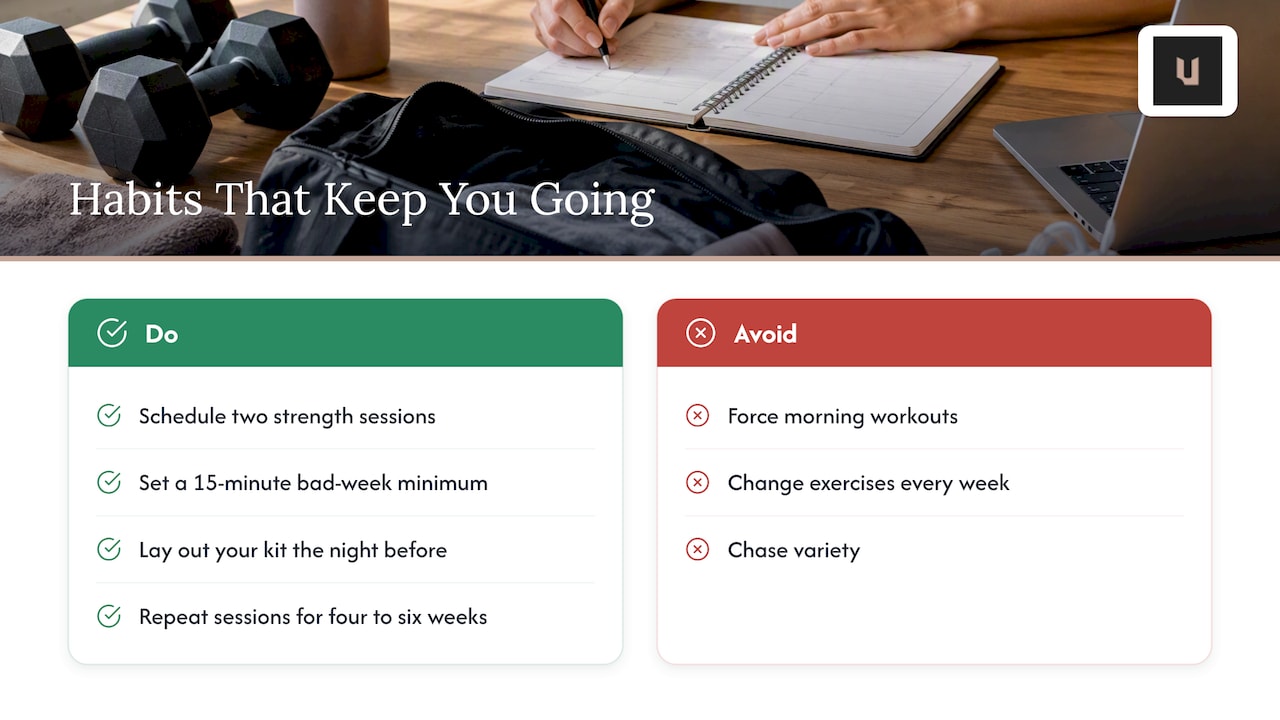
Book it like a meeting. Put your two strength sessions in your calendar as fixed appointments. If it is not written down, it moves.
Set a minimum. Decide in advance what a “bad week” looks like. For example: two 15-minute sessions. Then a bad week still counts.
Lay out your kit. Put your trainers by the door the night before, or keep a bag in the car. Cut every small bit of friction.
Pick a time of day that survives your job. If meetings spill over in the evening, train early or at lunch. If you are not a morning person, do not force it.
Do not chase variety. Repeat the same session for four to six weeks and try to add a little weight or one more repetition. That is how you see progress. Boredom is better solved by changing the exercises every month or so than every week.
Train with other people. This is the big one, and it deserves its own section.
Most people who stop exercising do not stop because they lack knowledge. They stop because nobody notices when they skip. Exercising in a group gives you camaraderie and social support, and NHS physiotherapy-led strength and conditioning class guidance highlights that group support helps people carry on exercising once formal professional input ends. The social side is not a bonus. For many people it is the thing that keeps them consistent when motivation drops.

A small group is also different from a crowded class. With a handful of people and a coach watching, someone corrects your squat, adjusts the weight and changes the exercise when your knee or shoulder complains. That matters if you are busy and cannot afford to get injured, and it matters if you feel self-conscious in a big, busy gym.
Alternatives are worth knowing about by type, so you can choose honestly:
| Option | Good for | Watch out for |
|---|---|---|
| Home workouts | Zero travel time, free | Easy to skip, limited equipment, no one checking your form |
| Large commercial gym | Lots of equipment, long opening hours | Can feel intimidating, no guidance unless you pay for it |
| One-to-one personal training | Fully tailored attention | Highest cost, fixed appointment times |
| Small group personal training | Coaching, accountability and community at a shared cost | Set session times, so you need to plan around them |
| Online programmes | Flexible and cheap | Depends entirely on your own discipline |
We see the same pattern in Sheffield again and again. Busy people do not fail because they are lazy. They fail because they are given a plan built for someone with unlimited time, and when a week goes wrong, they feel they have failed and quit.
So we do it differently. We coach small groups, and every programme is tailored to the person: their goals, their history, the sore knee from five-a-side or the stiff back from the commute. Each session has a clear purpose, so you are not wandering around wondering what to do next. We want training to feel welcoming rather than intimidating, because people come back to places where they feel they belong.
Our advice for anyone short on time is simple. Be strong twice a week. Move a bit every day. Do not wait for a quiet month, because it will not arrive. And find people to train with, because that is the part of the plan that does most of the work when your motivation takes a day off.
— Vitalij
If you live or work in Sheffield and want a plan built around your diary, our small group personal training gives you individual coaching in a friendly group, with sessions that are purposeful from the first minute. If you prefer variety and energy, our fitness classes, including Conditioning and Hybrid are another way in. Not sure which suits you? Get in touch through our website and we will talk it through. Prefer to start with community first? Our guide to beginner fitness classes in Sheffield is a good place to begin.
Two full-body strength sessions of about 30 minutes, spaced a couple of days apart, plus some brisk walking or a short interval session. That matches the UK guidance of strength work on at least two days a week. On very busy weeks, cut the sessions to 15 minutes rather than skipping them.
Yes, to a useful degree. Research on low-volume interval training suggests that sessions of 15 minutes or less, with a few minutes of hard effort, can improve heart and metabolic health. Check with your GP first if you have a health condition or have been inactive for a long time, and build up gradually.
Use the 30-minute session above on three non-consecutive days, such as Monday, Wednesday and Friday. Keep the weights moderate, focus on form and add a little load every couple of weeks. Two days is enough to meet the guidance, so a third day is a bonus, not a must. Our guide on full body versus split training explains how to choose.
Train with other people, set a small target such as adding one repetition each week, and swap a few exercises every month. Groups and classes help because the session changes and the people around you keep it lively. Boredom is often a sign that you are training alone with no goal.