
A personalised training plan is a short, measurable schedule built around one clear outcome and your real constraints. Start by naming your specific goal and the days you can actually train each week. The best plans follow established activity and strength guidance rather than reinventing it, and they stay simple enough that you will still be following them in eight weeks.
TL;DR:
- Adults should aim for 150 minutes of moderate activity or 75 vigorous minutes weekly, plus major muscle group strengthening on at least two days.
- Set one measurable outcome, then account for weekly availability, recent ability, equipment, recovery, and health concerns before choosing a training structure.
- Start with five or six full body exercises for two to three sets of eight to twelve reps, resting a day between two weekly sessions.
- Review your plan after four to eight weeks, tracking adherence and one performance measure before changing only one training variable at a time.
- Choose coached small group training when a complex schedule, recovery needs, or health history calls for weekly adjustments, or when accountability is your main hurdle.
A plan built around your own schedule, ability and goal gives you clearer progression, because every session has a purpose instead of copying a generic routine. It also tends to produce better adherence: you are more likely to repeat a plan that fits your week than one borrowed from someone with different constraints. Safer load management follows naturally, since the starting point matches your current ability rather than an assumed average.
Two public health benchmarks anchor this. NHS guidance recommends adults aim for at least 150 minutes of moderate activity, or 75 minutes of vigorous activity, each week, alongside muscle-strengthening work for all major muscle groups on at least two days. The 2026 ACSM resistance-training update draws on 137 systematic reviews and over 30,000 participants, and its central message is that individualised load and volume, matched to a person’s goal and circumstances, matters more than following a rigid template.
According to the ACSM update, moving from no resistance training to any regular resistance training is the most meaningful change most adults can make. The practical takeaway: simplicity and consistency beat complexity almost every time.
A plan only counts as personalised once it accounts for these six things. Skip any one of them and you end up with a generic routine wearing a personalised label.
The NHS England personalised care handbook describes the same logic for health planning more broadly: start with the person’s outcome and real constraints, then build measurable actions around them. For anyone over 65, the NHS guidance for older adults adds that activity should be adapted to current fitness, with daily movement and at least two days of strength and balance work, and a GP check where there are existing health concerns.
Building a workable plan is a short sequence, not a complicated system.
The NHS Better Health service follows a near-identical process: clarify the outcome, record constraints, choose measurable actions, begin achievable, then track and adjust as circumstances change.
Pro Tip: Write your review date in your calendar the same day you start the plan, not after you have already drifted off it.
These two templates cover most general fitness goals and can be adapted to your own equipment and schedule.
| Template | Sessions per week | Rep range | Sets |
|---|---|---|---|
| 2-day strength starter | 2 | 8 to 12 | 2 to 3 |
| 3-day mixed | 3 | 8 to 12 (strength day) | 2 to 3 |
The NHS strength guidance recommends exactly this starting range, 8 to 12 repetitions per exercise with at least two sets, building up gradually over several weeks rather than jumping straight to heavier loads.
Once you are training for a specific event, the plan should work backwards from what that event demands. British Cycling’s approach organises plans by goal and ability, prioritising an A‑event and structuring the weeks before it around that demand.
Runners managing a heavier training load may also find value in a practical guide to avoiding burnout, which covers recovery habits that complement a structured plan.
Progression works best as a single small change at a time rather than several at once.
The approach differs slightly by priority. The ACSM 2026 update frames strength-focused training around heavier loads and lower reps, hypertrophy around moderate loads and moderate reps, and endurance-focused training around lighter loads and higher reps. Recovery weeks become necessary when sessions that used to feel manageable start feeling consistently hard, when sleep or motivation drops, or when a performance test stalls or slips backwards.
Three simple metrics are enough to track: a session rating of perceived exertion (how hard each session felt), a weekly adherence percentage (sessions completed against sessions planned), and one performance test repeated every few weeks, such as a timed run or a maximum lift.
Some readers prefer a coached version of this same process rather than managing it alone. At Unit Health & Performance, small-group personal training applies the same inputs covered above, goal, schedule, ability, equipment and health history, but a coach records them and adjusts the plan session by session.
Choosing coached small-group training over self-guided templates tends to make the most difference when your schedule, recovery or health history is complex enough that weekly adjustments matter, or when accountability is the main thing you are missing. Our guide on group personal training versus one-to-one coaching covers how to choose between formats in more depth.
A training plan changes what your body needs to recover and adapt, which is why nutrition guidance usually sits alongside it rather than as an afterthought. Strength-focused training increases the need for adequate protein spread across the day to support muscle repair, while higher-volume endurance training increases the need for enough overall energy intake to avoid constant fatigue. Neither of these points requires a complicated diet plan: they simply mean your eating pattern should match what your training week is asking of your body.
For most people starting a personalised plan, the practical approach is to eat enough to support the sessions you are doing, prioritise protein at each meal, and keep hydration consistent around training days. Someone training two or three times a week for general fitness has very different nutritional demands to someone following a structured cycling or running plan with higher weekly volume, so the guidance should scale with the plan itself rather than staying fixed.
Nutrition also interacts directly with recovery and progression. Under-eating relative to training load is one of the more common reasons a plan stalls: performance plateaus, recovery slows, and the progression rules outlined earlier in this guide stop working as expected. Getting this right does not require tracking every gram, but it does mean treating food as part of the plan rather than a separate decision made in isolation from it. Where a plan includes a coach, nutrition guidance is often folded into the same check-ins used to review training progress, which keeps both moving in the same direction instead of working against each other.

A plan that only specifies sets, reps and sessions misses half of what actually determines whether someone keeps training. Motivation dips are normal, and a well-built plan anticipates this rather than assuming willpower alone will carry you through eight or twelve weeks of consistent effort.
One of the simplest strategies is tying the plan to a specific, personally meaningful outcome rather than a vague intention, since a concrete target (a time, a weight, an event date) gives you something to measure progress against on days when motivation is low. Breaking a longer-term goal into shorter review points, as covered in the step-by-step process earlier, also helps: four to eight weeks is a far more manageable mental horizon than an open-ended commitment.
Self-monitoring matters too. Writing down completed sessions, even briefly, creates a visible record of consistency that is easy to lose track of otherwise, and that record becomes its own form of reinforcement over time. Choosing activities you find genuinely tolerable, rather than ones you feel obligated to do, also supports longer-term consistency, which is part of why the ACSM update linked earlier in this guide places enjoyment alongside load and volume as a factor worth individualising.
Setbacks are easier to manage when the plan treats a missed session as routine rather than a failure. Building in some flexibility from the start, rather than treating the plan as rigid, makes it far easier to pick back up after a disrupted week instead of abandoning it altogether.
Training alongside other people changes the experience of sticking to a plan in ways that training alone often does not replicate. A scheduled session with other people attending creates a social commitment that is harder to skip than a solo session you can quietly postpone, and that small shift in accountability compounds over weeks and months.
Community support also supplies a form of feedback and encouragement that is difficult to generate for yourself. Seeing other people working towards their own goals, at their own pace, tends to normalise the effort involved and make the process feel less isolating, particularly during the early weeks when progress is not yet visible. This is one reason small-group formats, where sessions are shared but programming stays individual to each person, have become a popular middle ground between fully solo training and one-to-one coaching.
Shared environments also help with the practical side of adherence. A consistent time and place, attended alongside familiar faces, reduces the number of decisions you need to make each week, since the session is already scheduled and expected rather than something to negotiate with yourself each time. Over a period of months, that reduction in daily decision-making is often what separates a plan that lasts from one that quietly stops.
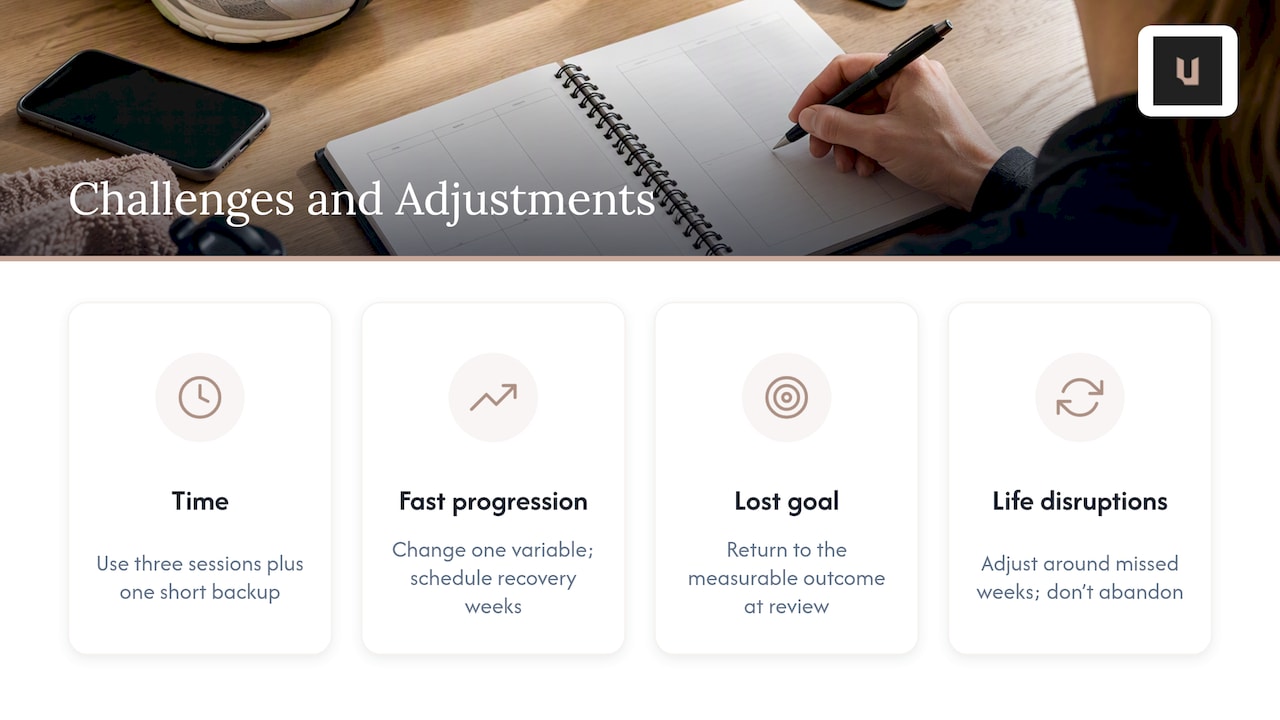
Even a well-built plan runs into predictable obstacles, and knowing them in advance makes them easier to manage.
The most common challenge is simply running out of time in a given week. The fix is building flexibility into the plan from the outset: a three-session week with one shorter backup session is more resilient than a rigid four-session week with no fallback option.
A second common challenge is progressing too quickly, which tends to show up as nagging fatigue or stalled performance rather than a single dramatic setback. The progression rules covered earlier in this guide, changing one variable at a time and scheduling recovery weeks, are the direct counter to this.
A third challenge is losing track of why the plan exists in the first place, particularly once the initial motivation that started it fades. Returning to the single measurable outcome defined in step one, and checking progress against it at the review point, re-anchors the plan without needing to start over.
Finally, many people underestimate how disruptive life events, illness, travel, a demanding work period, can be to a training schedule. Treating a missed week as something to adjust around, rather than a reason to abandon the plan entirely, keeps momentum intact. A short, realistic plan that survives disruption will always outperform an ambitious one that collapses at the first missed session.
Adherence is the outcome that matters most. A plan you actually follow for ten weeks will beat a perfect-looking plan you abandon after two. Use the templates above as a starting point, not a final answer, and review early rather than waiting for everything to feel settled.
— Vitalij
Building and adjusting your own plan works well for many people, but some simply want the process handled by someone watching how they respond week to week. Small-group personal training can be built around an individualised approach, with sessions adjusted to your goal, schedule and ability rather than a fixed class structure.
Visit our Small Group PT page to see how an initial consultation works and book your first session.
Several fitness apps let you build and log your own workouts, though most focus on tracking rather than personalising a plan around your specific constraints. The process covered in this guide, defining your outcome, recording your schedule and ability, then choosing a structure, works whether you log it in an app, a spreadsheet or on paper.
There is no single recognised 3-2-1 training rule in major guidance such as NHS or ACSM publications, and the phrase is used differently across various fitness sources. Rather than relying on an informal rule, base your weekly structure on the NHS recommendation of at least 150 minutes of moderate weekly activity plus strength work on two or more days.
The two starter templates covered in this guide, a 2-day strength session and a 3-day mixed session, give personal trainers a simple structure to adapt for clients with different goals and schedules. Adjusting rep ranges, session count and exercise selection to each client’s baseline keeps the template personalised rather than generic.
Building a personal training business sits outside the scope of designing a training plan, and this guide focuses on how to personalise workouts rather than run a fitness business. For programming structure specifically, the step-by-step process and FITT‑VP framework covered above apply equally whether you are planning for yourself or for clients.