Grip strength is how hard you can squeeze. After 40 it slowly drifts down unless you train for it, and researchers treat it as a handy sign of how strong the rest of your body is. The good news: you can improve it at any age, and you do not need a drawer full of hand grippers to do it. Heavy, regular, whole-body strength work does most of the job, with a few grip-specific exercises on top.
Below you will find typical UK numbers for your age, what a weak or strong grip does and does not tell you, and a plain weekly plan.
It sounds odd that a hand squeeze would matter for your health. The reason is that grip tracks overall muscle. NHS-linked research describes hand grip as a simple, non-invasive marker of whole-body muscle strength and function that is cheap enough to use in clinics. A 2024 Worcestershire assessment goes further and says handgrip is a reliable indicator of total muscle strength and mass, worth checking before people reach frailty or a higher risk of falls.
In plain terms: a weak grip is a flag, not a diagnosis. It does not mean your hands are the problem. It often means your muscles overall have been under-used for a while.
That is also why the “grip and longevity” headlines need handling with care. Studies link weaker grip with poorer health later in life, but squeezing a gadget will not by itself add years. What helps is the habit behind a strong grip: lifting, carrying and pulling regularly, and keeping that up for decades.
There is no single number. Grip changes with sex, age, height, which hand you use and even whether you test sitting or standing.
Here is what the best UK data shows.
| Group | Typical value (median) | Wider range (5th to 95th percentile) |
|---|---|---|
| Men aged 50 to 54, standing | 45 kg | 32 to 58 kg |
| Women aged 50 to 54, standing | 28 kg | 15 to 38 kg |
| Men and women aged 55 to 59, standing | 45 kg and 28 kg | Not shown here |
| Men aged 85 and over, standing | 27 kg | Not shown here |
| Women aged 85 and over, standing | 16 kg | Not shown here |
These figures come from a 2026 analysis of the English Longitudinal Study of Ageing. The authors present them as population reference values, not targets you must hit.
Going back to younger adults, an analysis of 12 British studies with 49,964 participants found that median grip peaks at around 51 kg for men aged 29 to 39 and 31 kg for women aged 26 to 42. It then declines from midlife. By age 80, weak grip (a strict definition in that study, at least 2.5 standard deviations below the peak average for your sex) affected about 23% of men and 27% of women.
What does that mean for you at 40-something? If you sit around the middle of your age group, you are typical. If you are well below, it is a reason to start strength training, not a reason to worry. If you are above, keep doing what you are doing.
People search this a lot. A 200 lb reading is about 90 kg, which is the very top of the scale on a JAMAR hand dynamometer, a device that reads 0 to 90 kg (0 to 200 lb). That would be far above the English reference ranges for adults in their 50s. If you or a friend got that number, it is more likely a different device, a different way of testing, or a mix-up between one-hand and combined scores than a health benchmark. Treat it as a gym curiosity.
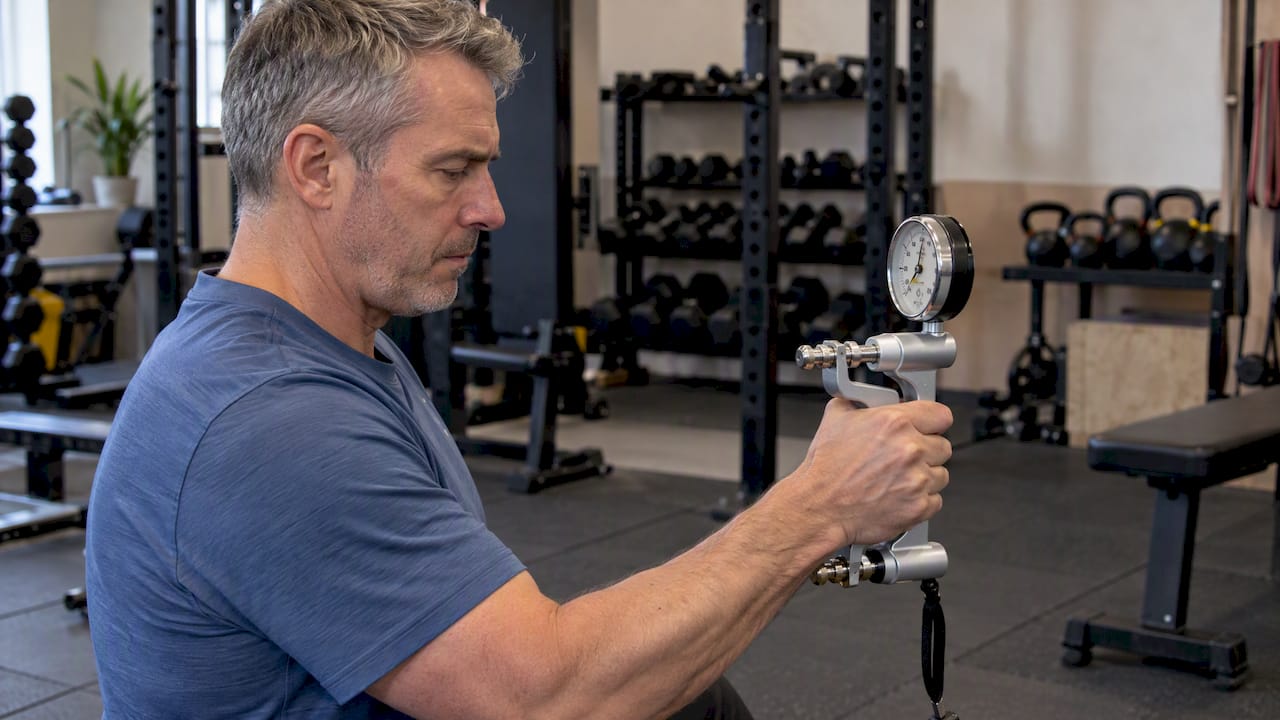
A grip score only means something if the test is the same each time. The NHS Southampton procedure for the JAMAR uses an adjustable handle with five positions and set instructions, and the 2026 English study treats standing and sitting tests separately.
So, for your own tracking:
The trend matters more than the number. A rise of a few kilos over three months, with the same set-up, is real progress.
Yes. This is the question behind most grip searches. The NHS explains that strength exercises make muscles work harder than usual, which increases strength, size, power and endurance, and it recommends working all the major muscle groups on at least 2 days a week. GOV.UK adds that strengthening activity can help reduce age-related muscle loss, which can also happen after a period of not moving much, at any age.
You do not need to start with a heavy barbell either. A systematic review of 1,388 adults found that chair-based exercise improved handgrip strength, and the evidence on older adults points to training that is matched to the person and made harder step by step. Start where you are, then progress.
If you want a fuller plan, our guide to two strength sessions a week for over 40s covers how to set it up.
Grip responds to three kinds of work: holding something heavy, hanging from something, and pulling things hard. You can cover all three in two sessions a week.
Deadlifts, rows, pull-downs and carries all make your hands work, because they have to hold the weight. If your grip gives out before your legs and back do, that is your cue to add specific grip work. If it does not, the main lifts are already doing the job.
| Exercise | How to do it | Start with |
|---|---|---|
| Farmer’s carry | Hold a dumbbell or kettlebell in each hand, stand tall and walk slowly without swinging them | 3 walks of 20 to 30 seconds |
| Dead hang | Hang from a bar with straight arms and shoulders pulled gently down. Keep your feet on a box or the floor if you need help | 3 holds of 10 to 20 seconds |
| Towel or thick-handle row | Wrap a towel round the handle, or use a thicker bar, to make the same row harder to hold | Your normal row, a bit lighter |
| Plate pinch | Pinch two small plates together, smooth sides out, and hold | 3 holds of 15 to 20 seconds |
Keep the effort hard but controlled, finishing each set feeling that the last few seconds or reps were tough. Do not grind through sharp pain.
Each week, change just one thing: a few more seconds, a slightly heavier weight, or one more walk. Our post on progressive overload for beginners explains why one small change beats a perfect plan.
A Derbyshire evidence review stresses programmes delivered over at least 12 weeks, so judge your progress over a few months, not a few days. Rest days matter too. Hands, wrists and elbows have lots of small tendons that recover more slowly than big muscles, so avoid doing hard grip work on back-to-back days.
If you are choosing between full-body and split sessions, our comparison of full body versus split training will help. Two or three full-body sessions suit most busy people.
Grip is a useful signal, but it is not the whole picture. GOV.UK reports that poor muscle strength raises the risk of falls in older adults by 76%. Falls are mostly a leg, balance and trunk problem, not a hand problem. If you want to see how falls prevention is explained in practice, this overview of falls prevention for older adults is a helpful read, though note it is written for Australia.
A good over-40 plan therefore includes squats or sit-to-stands, single-leg work, some balance practice and core work, alongside the grip exercises. Our guide to bone density exercises after 40 shows how the same strength days support your bones too.
Protein alone will not fix a weak grip. A 2021 systematic review found protein supplements on their own did not improve grip strength, but protein combined with resistance exercise did in older adults.
For a practical target, Royal Berkshire NHS guidance suggests 20 to 40 g of protein per meal helps maintain or build muscle. That is roughly a palm-sized portion of chicken, fish, eggs or tofu, or a pot of Greek yoghurt with some nuts. For a food-first explanation aimed at midlife, see this guide to protein targets after 40.
A caution: if you have kidney disease, do not raise your protein without advice. Royal Devon NHS says people with kidney disease should get guidance from their clinician or dietitian because higher-protein eating may not suit them.
Training is for a healthy, ordinary decline. It is not for everything.
At Unit, we see this all the time with members over 40. People arrive worried about one thing, such as a jar they cannot open, or a bag that feels heavier than it used to. What they usually need is a regular, well-coached routine that works the whole body.

We do not think you should chase a grip number. We think you should be able to carry your shopping, lift a suitcase, hang off a bar if you fancy it, and still be doing it at 70. That means two strength sessions a week, exercises that are scaled to you, and gradual progress.
The common mistake we see is trying to do too much too fast, then stopping when an elbow or shoulder complains. Our approach is the opposite: start lighter than your ego wants, learn good technique, and add a little each week. Grip improves almost as a side effect. Many of our members find it easier to stay consistent in a small group, where a coach adjusts the session to each person and you are not left guessing alone.
— Vitalij
If you would rather not work it out alone, our small group personal training is built for adults over 40 who want to get stronger, leaner and fitter. Every member gets an individual plan inside a small group, so you get a coach’s eye on your technique without the cost or pressure of one-to-one sessions. We also run fitness classes for adults, and a friendly, non-intimidating gym is the point. Over 100 members train with us in Sheffield. Get in touch via our website to ask about a place.
If you want to compare options first, our guide to strength training classes in Sheffield explains what to look for.
In English adults aged 50 to 59, the middle value standing is about 45 kg for men and 28 kg for women, with a wide healthy range around that. Younger adults peak higher, at around 51 kg for men and 31 kg for women. Use these as a rough guide only, since device, hand and posture all change the score.
Most people notice they can hold things for longer within a few weeks. Measurable strength gains usually need a few months of regular training, and evidence on older adults supports programmes of at least 12 weeks. Keep your test method the same so you can see real change.
Studies link weaker grip with higher risks of disability and poorer health later in life. But grip is a marker of overall muscle, not a cause on its own. The best way to act on it is to do regular whole-body strength training, not to squeeze a gadget.
Light work such as carrying shopping is fine every day. Hard grip training, like heavy hangs and carries, is better limited to two or three days a week with rest in between, because tendons in the hands, wrists and elbows recover slowly. If anything starts to ache sharply, ease off and see a physio if it persists.