A two day full body split means you train your whole body in each session, twice a week, with rest days between. It is enough to get stronger. Research finds no meaningful difference in strength or muscle gain between this and more complex splits when the total work is the same. Below you will find the plan, the spacing, the sets and reps, and how to keep progressing.
Yes. This is the question most people have before they start, so here is the evidence in plain terms.
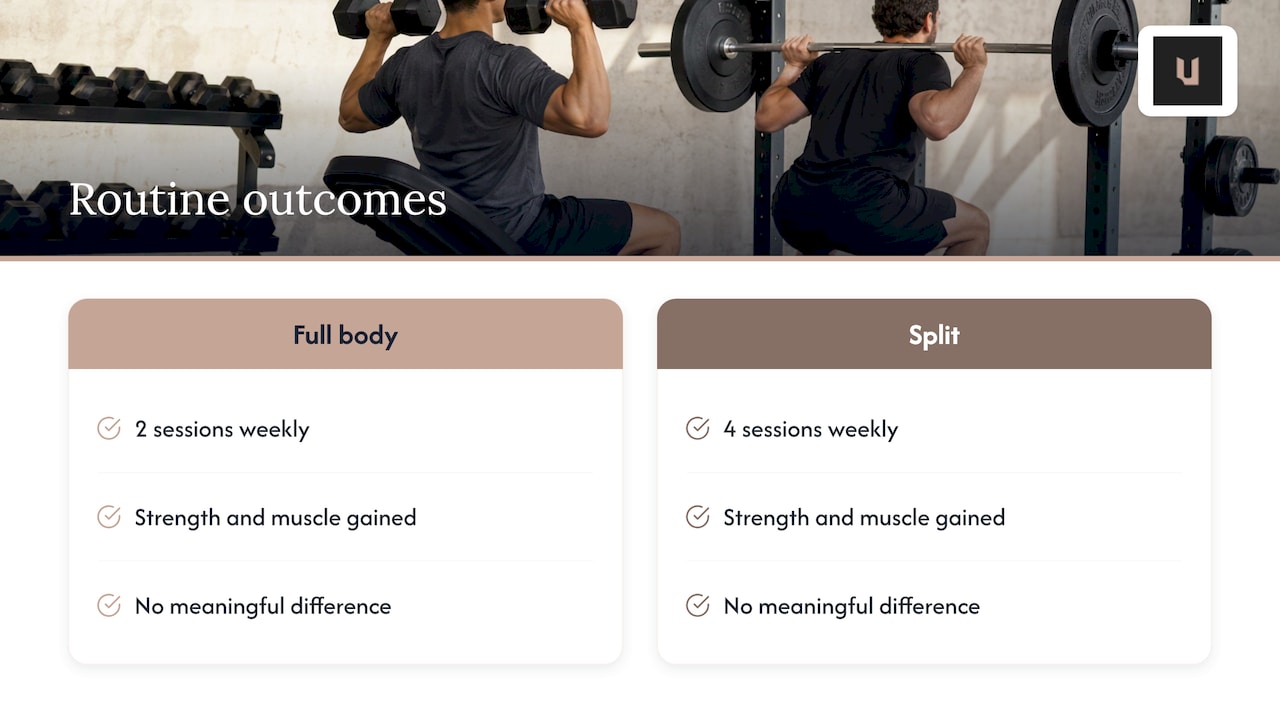
A 2024 review of 14 studies with 392 people compared split routines with full body routines. When the amount of work was matched, it found no significant difference in strength or muscle growth. Its conclusion was that people can choose the routine they prefer.
An earlier 2018 analysis of 22 studies reached a similar view on training frequency: with volume equal, how often you train had no significant effect on strength gains.
A 2022 trial in 50 untrained women is a good real-world example. One group did two full body sessions a week. The other did four split sessions. Both gained strength and muscle, with no meaningful difference between them.
The catch is the phrase “when volume is equal”. Two sessions have to carry enough work. That is why the plan below uses big exercises, real effort and steady progress.
The NHS says adults aged 19 to 64 should do strengthening activities that work all the major muscle groups (legs, hips, back, abdomen, chest, shoulders and arms) on at least 2 days a week. The same guidance asks for at least 150 minutes of moderate activity a week.
The UK Chief Medical Officers say the same about muscle strengthening on two days, and note it can help lower the risk of sarcopenia, the loss of muscle with age. A Public Health England review recommends resistance training at least twice a week using a weight you can lift 8 to 12 times with good technique.
So a two day full body split is not a shortcut. It matches what UK health bodies ask of every adult.
Leave rest days between the workouts. The National Strength and Conditioning Association (NSCA) suggests that beginners who train the whole body use non-consecutive days, with 1 to 3 days between sessions but never more than 3.
In practice, these patterns work well:
| Pattern | Session 1 | Session 2 | Rest days between |
|---|---|---|---|
| Classic | Monday | Thursday | 2 after the first, 3 after the second |
| Mid-week | Tuesday | Friday | 2, then 3 |
| Weekend-friendly | Wednesday | Saturday | 2, then 3 |
BIP Fitness, in its free two day plan, also suggests two or three rest days between sessions, for example Monday and Thursday or Tuesday and Friday. Avoid Saturday then Sunday back to back. Your muscles need time to recover, and the second session will feel worse for it.
Your other days are for walking, cycling, swimming or a class. That helps you reach the 150 minutes of moderate activity too.
The layout below uses two different workouts, A and B, so you train each movement pattern with a slightly different exercise each time. Each one covers the main movement types: squat, hinge, push, pull and single-leg work. Strength coach Eugene Teo’s minimalist plan, reported by Men’s Health UK, uses this same pattern in every session.
The exercise choices below are modelled on the structure of BIP Fitness’s free two day programme, which pairs squat, bench press, row and Romanian deadlift in one workout with deadlift, overhead press, pulldown and Bulgarian split squat in the other. I have made a few swaps to keep it simple and kind to the joints.
| Exercise | Sets | Reps |
|---|---|---|
| Goblet squat or back squat | 3 | 6 to 8 |
| Dumbbell or barbell bench press | 3 | 6 to 8 |
| Seated row or barbell row | 3 | 8 to 10 |
| Romanian deadlift | 3 | 8 to 10 |
| Dumbbell lateral raise | 2 | 12 to 15 |
| Plank | 3 | 30 to 45 seconds |
| Exercise | Sets | Reps |
|---|---|---|
| Deadlift or trap bar deadlift | 3 | 5 |
| Overhead press (dumbbell is fine) | 3 | 6 to 8 |
| Lat pulldown | 3 | 8 to 10 |
| Split squat or step-up | 3 | 8 to 10 |
| Incline dumbbell press | 2 | 8 to 12 |
| Hanging or lying knee raise | 3 | 10 to 12 |
Each session takes about 60 to 70 minutes at a relaxed pace, in line with the BIP programme. If that is too long, see the time-saving section below.
Keep it simple: 2 to 3 sets per exercise, in the 6 to 12 rep range. Here is what the sources suggest.
The common thread is effort. The weight should feel hard by the end of each set, but your technique should stay clean. That is what the Public Health England review means by higher intensities giving greater gains.
Busy weeks happen. When you cannot give an hour, cut sets, not exercises. The minimalist plan reported by Men’s Health UK runs each session for around 30 to 40 minutes. It uses one warm-up set and one hard working set per movement, with a squat, hinge, push, pull and single-leg exercise in each workout. Its coach’s point is that intensity matters more than volume.
Here is how that looks for you:
This is a good fit if you have a full diary. We cover more ideas in our guide to workouts for busy professionals.
A plan only keeps working if it gets a little harder over time. The rule is simple, and BIP Fitness states it well: once you hit the top number of reps on every set, add the smallest step of weight next week. If you miss it, repeat the same weight.
Example: your bench press target is 3 sets of 8. This week you manage 8, 8, 8 with 20 kg dumbbells. Next week you move up to the next dumbbell size. If you only manage 8, 7, 6, stay on the same weight until you get there.
Men’s Health UK gives the same advice: record weights and reps, and increase the load once you complete all sets at the top of the rep range. A notebook or phone note is all you need.
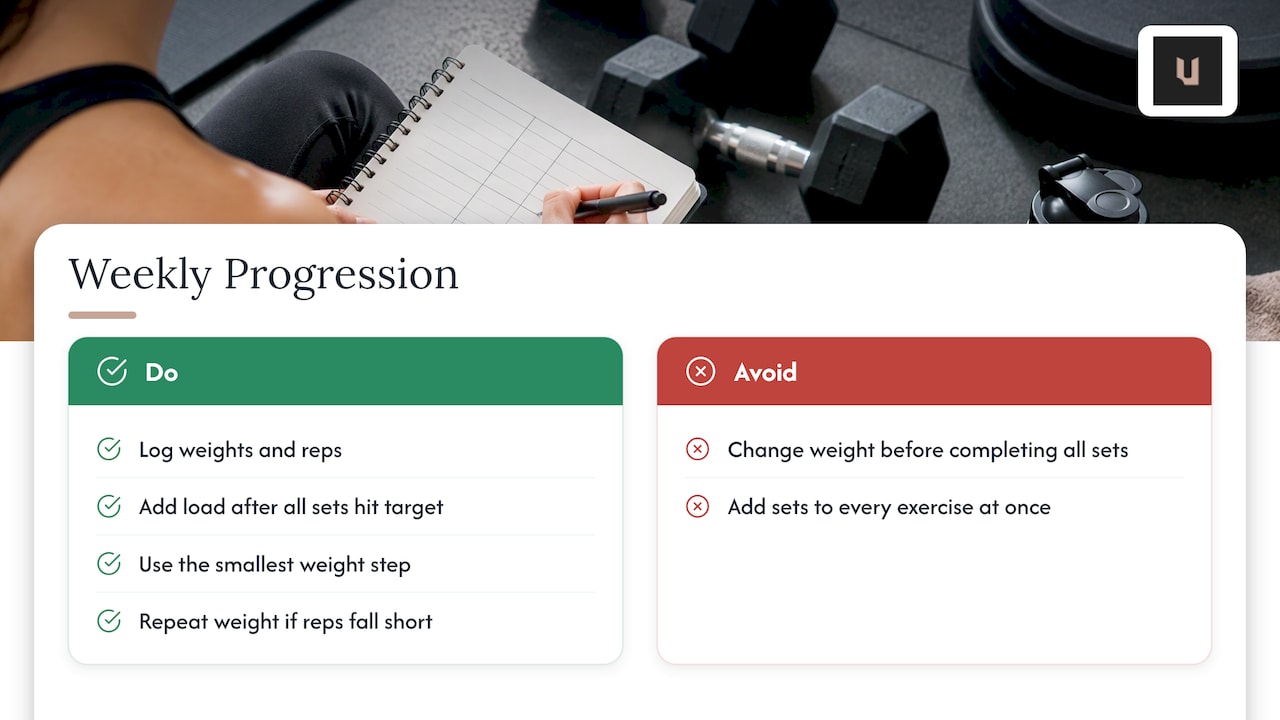
If you want to raise the amount of work you do, not just the weight, do it slowly. This guide on how to increase workout volume safely suggests adding one set at a time every one to two weeks. Add a set to one or two exercises, not all of them at once.
If your lifts keep dropping, trim a set from each exercise for a week. The Warwick review notes that more sessions do not always bring bigger effects, and a lower frequency gives more time to recover. Quality beats quantity.
Two full body days suit adults over 40 well, because recovery between sessions is built in. Some tips:
If you are returning after a break, begin with two sets per exercise and the lower end of the weights. The NSCA advises beginners to train two or three days a week, never leaving more than three days between sessions.
Want more detail? Our related guides cover full body versus split training for adults over 40, twice a week strength training over 50 and strength training for over 40s. If joints are a worry, see our page on low impact strength training.
If you have a medical condition, an injury, or are on medication that affects exercise, speak to your GP or a physiotherapist before you start. They can tell you which movements to avoid.
We coach adults over 40 in small groups in Sheffield, and the same pattern turns up again and again. People rarely fail because their programme was not clever enough. They fail because it did not fit their week, or because they felt lost or out of place in a big gym.
That is why we like the two day full body approach as a base. It is simple, it is backed by UK guidance, and it leaves room for work, family and recovery. The trick is making each session count: the right exercises, the right weights and someone watching your technique.
In our small group personal training, each member gets an individualised plan within a friendly, non-intimidating group. Our coaches help you pick the right lifts, adjust for old injuries and know when to add weight. We built it around sustainable results and long-term health, not quick fixes.
Vitalij
If you would rather have the plan built around you, our small group personal training in Sheffield gives you individualised coaching in a small, supportive group. It is designed for adults who want to get stronger, leaner and fitter, including people over 40. You can also look at our fitness classes if you want extra sessions on your off days. Prefer to read first? Our guide to strength training classes in Sheffield is a good place to start.
Get in touch through our website to ask about what suits you.
For most people, yes, as long as you work hard and add weight over time. A 2024 review found no significant difference in muscle growth between split and full body routines when volume was equal. Two well-planned sessions can match a longer programme for beginners and busy adults.
Any two non-consecutive days work. Monday and Thursday, or Tuesday and Friday, are the most common. The NSCA advises 1 to 3 days between sessions, never more than 3. Choose the pair you can keep up week after week.
Between 30 and 70 minutes, depending on the sets you do. A short version with one or two hard sets per exercise can take 30 to 40 minutes. A fuller version with three sets runs closer to an hour.
It is a sensible choice. The long rest between sessions helps recovery, and the big compound lifts train the whole body efficiently. One coach quoted in Men’s Health UK recommends 2 sets per exercise for this age group, moving to 3 when recovery allows. Choose joint-friendly versions of the lifts.
When two sessions feel easy to recover from and you have the time. Add the third day gradually, keeping rest days between. Our guide to full body versus split training explains how to make that step.