
Playing more matches isn't the secret to breaking through a performance plateau; it's often the very thing holding your child back. You've likely watched your young athlete give everything at team training, yet they're still struggling to find that extra gear or are constantly battling minor "niggle...
Playing more matches isn't the secret to breaking through a performance plateau; it's often the very thing holding your child back. You've likely watched your young athlete give everything at team training, yet they're still struggling to find that extra gear or are constantly battling minor "niggles" and growing pains. Improving youth sport performance Sheffield wide requires a shift from just playing more sport to building a robust physical engine that can handle the high demands of competition.
This 2026 guide explains how specialised physical development helps young people aged 10 to 17 gain explosive speed, build resilient strength, and significantly lower their risk of injury whilst they grow. We'll explore how a professional, coach-led environment and objective progress tracking can bridge the gap between local club level and elite academy standards. By the end, you'll see a clear pathway to giving your child the physical confidence they need to excel on the pitch and reach the next level of their sporting journey.
• Understand why technical skill alone isn't enough and how closing the "performance gap" prevents plateaus whilst protecting against recurring injuries.
• Learn the three critical phases of athletic development to ensure your child masters movement quality before progressing to explosive power and speed.
• Discover how to evaluate the best environment for youth sport performance Sheffield has to offer by prioritising coaches who specialise in teen-specific training.
• Find out how a simple movement assessment can provide a clear roadmap for your child to move from local club participation to academy-level resilience.
Many parents believe that more time on the pitch is the only way to improve. However, true youth sport performance Sheffield relies on building a solid foundation of physical literacy first. This means developing the strength, coordination, and body awareness that allow an athlete to move efficiently. When technical skills outpace physical capabilities, we see a "Performance Gap." A young footballer might have the footwork to beat a defender, but if they lack the leg strength to decelerate or change direction safely, they are at a much higher risk of injury. Simply playing more matches doesn't fix this; it often makes it worse by overloading a body that isn't yet robust enough for the demand. Training like an athlete means prioritising how you move before how much you play.
Focusing on a single sport too early can actually hinder long-term success. Whilst it's tempting to specialise, it often leads to overuse injuries and mental burnout. Building a versatile athletic engine through multi-sport movements ensures that young athletes develop a wider range of motor skills. This variety makes them more resilient and adaptable on the field, which is a cornerstone of sustainable youth sport performance Sheffield programmes.
It's common to see performance stall during adolescent growth spurts. This "clumsiness" happens because the brain is essentially relearning how to control longer limbs. If your child's speed has plateaued or they seem less coordinated, it's a sign they've reached the limit of their natural growth. Moving into a structured youth athlete program helps them regain control. By focusing on coordination and core stability, they can turn that sudden growth into a performance advantage rather than a hurdle.
Long-Term Athletic Development (LTAD) is a structured roadmap that ensures a child's training matches their biological age rather than just their birth year. We focus on three specific phases: movement quality, then capacity, and finally power. This sequence ensures a teenager builds a solid base before adding intensity. To truly enhance youth sport performance Sheffield athletes need more than just effort; they need objective data. Using video analysis and sprint timing helps teens see their own progress, turning abstract goals into visible wins. This systematic approach is what separates a casual gym session from professional athletic preparation.
In most UK team sports, top-end speed is rarely reached. The game is won or lost in the first 3-5 steps. Acceleration is the ability to reach high speeds quickly from a standstill or a slow jog. Our speed and agility training Sheffield focuses on these explosive bursts. By improving a player's "first step" quickness, we give them the edge needed to reach the ball first or track a runner more effectively. It's about being sharp and reactive, not just running in straight lines.
Many parents worry that gym work is dangerous for growing bodies, but age-appropriate strength and conditioning Sheffield is actually a protective measure. We view strength training as building "body armour." It isn't about lifting the heaviest weights possible; it's about mastering movement competency. By learning how to squat, lunge, and land correctly, young athletes build the resilience required to withstand the physical nature of competitive sport. Age-appropriate drills are the secret to the high-level youth sport performance Sheffield coaches look for in academy prospects. If you're curious about how these pillars fit your child's needs, you can chat with one of our coaches to learn more.
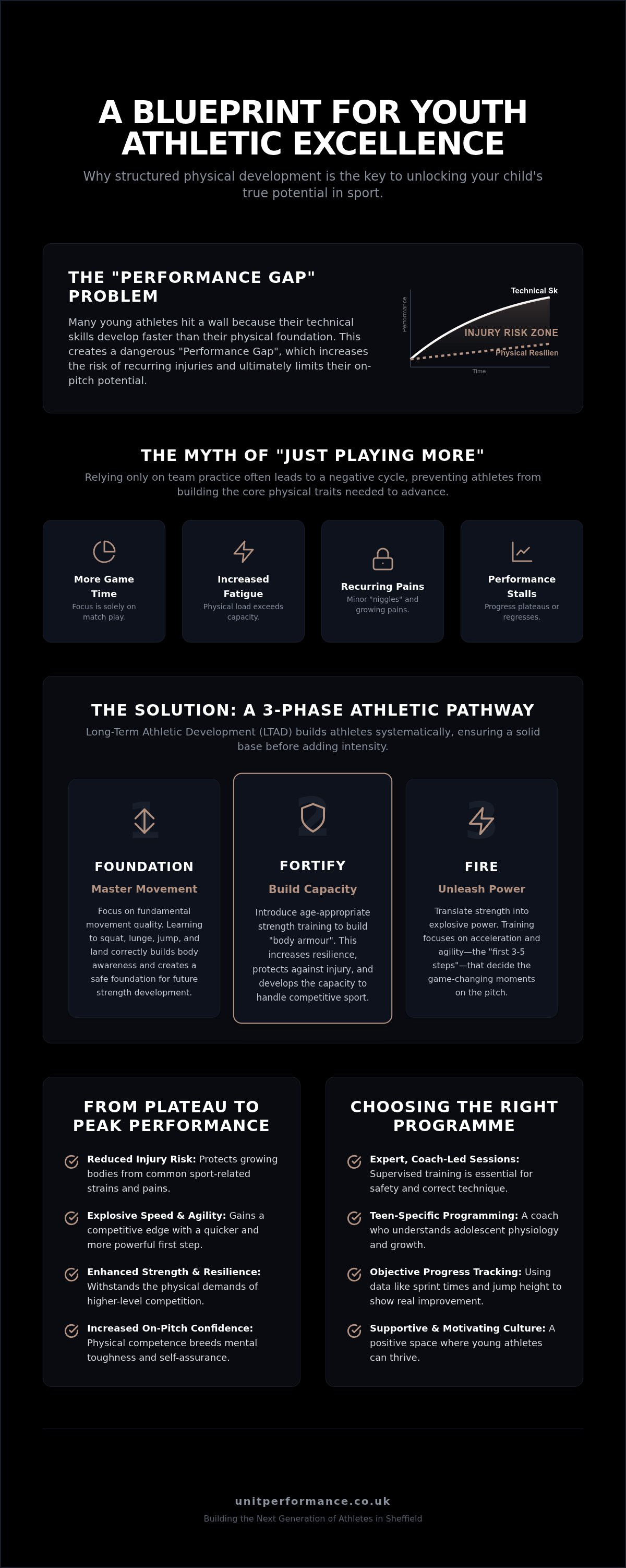
Selecting the right training space is just as vital as the drills themselves. Many commercial gyms offer unsupervised access, but for a 14-year-old, this can be counterproductive. To truly enhance youth sport performance Sheffield parents should prioritise coach-led environments over simple gym memberships. A specialist coach understands that a teenager isn't just a "small adult." They have unique recovery needs and physical vulnerabilities, such as sensitive growth plates, that require expert eyes. A supportive, non-intimidating culture ensures that the gym becomes a place they look forward to visiting.
Before committing your child to a programme, use these questions to vet a provider:
Experience with adult bodybuilders doesn't translate to the needs of growing athletes.
Programmes must be flexible enough to adapt when coordination temporarily dips.
Ask about supervision ratios and how they screen for movement quality.
"One size fits all" programmes usually fail because they don't account for the rapid developmental leaps common between ages 10 and 17. Effective coaching balances these gym sessions with existing school work and club commitments to prevent overtraining and keep the athlete fresh for match days.
Training shouldn't be a chore. When teens work out amongst peers in a group coaching gym Sheffield, they find a tribe of like-minded individuals. This collective energy builds a lifelong favourite habit of exercise whilst making the hard work of speed drills feel like a shared mission. A positive atmosphere fosters resilience that carries over into their academic life and match-day performance. If you want to see how our environment can support your child's specific goals, get in touch with us today.
The transition from a child who simply plays sport to a prepared athlete is a significant milestone. Whilst team practices are great for technical skills, they often lack the individualised physical preparation needed to truly excel. To elevate youth sport performance Sheffield athletes should move towards a structured youth athlete programme. This shift ensures they aren't just "active," but are building the specific speed and strength required for elite-level competition. We always recommend starting with a taster session. It's the perfect opportunity for our coaches to assess movement quality and for your child to feel the energy of our training environment.
Success in youth training comes from focusing on performance-based goals rather than just match outcomes. Winning a game depends on many factors, but improving a 10-metre sprint time or mastering a squat pattern is entirely within an athlete's control. In 2026, prioritise consistency over raw intensity. A teenager who trains twice a week with focus will always outperform one who trains sporadically at maximum effort. This steady progress builds the physical resilience needed to avoid the growing pains and recurring injuries that often stall a young person's development.
Our professional Sheffield facility provides a world-class setting where young people feel empowered rather than intimidated. We've created a space that balances high-level coaching with a genuine sense of belonging amongst peers. If you're ready to help your child bridge the gap between club participation and academy-level performance, please contact the team for a friendly chat. We'll discuss your child's specific needs and show you how our community can support their sporting ambitions. It's time to start the journey from active kid to resilient athlete.
Building a resilient athlete requires a shift in focus from simply playing more matches to developing a robust physical engine. By prioritising movement quality and age-appropriate strength training, young people can break through performance plateaus whilst significantly reducing their injury risk. We've been redefining youth sport performance Sheffield standards for over 10 years, providing expert-led sessions that bridge the gap between casual participation and elite-level competition. Our specialised SpeedAcademy and SuperStrong pathways offer a clear, safe route for teenagers to build the speed and confidence they need to excel.
Choosing a coach-led environment ensures your child receives the specific guidance their growing body requires. It's about more than just lifting weights. We foster a lifelong passion for physical excellence in a supportive community. If you're ready to see your child thrive on and off the pitch, book a taster session and start your youth athlete journey today. We're excited to help them unlock their full potential.
Strength training is entirely safe and highly beneficial for a 12-year-old when led by a specialist coach. Rather than lifting maximal weights, we focus on movement competency and bodyweight control. This approach builds "body armour" to protect growing joints and sensitive growth plates. It's a fundamental part of youth sport performance Sheffield programs, ensuring that your child develops the physical resilience needed for competitive team sports without unnecessary risk.
Most young athletes see the best results with one to two dedicated performance sessions per week. This frequency allows for significant physical development without interfering with their club training or match-day energy. Consistency is more important than intensity at this age. By maintaining a steady routine, they build long-term athletic foundations whilst allowing plenty of time for schoolwork and recovery, preventing the burnout often seen with over-specialisation.
Performance training provides the physical "edge" that academy scouts often look for, such as explosive acceleration and robust movement patterns. Whilst technical skill is vital, scouts prioritise athletes who possess the physical engine to handle elite-level demands. Our structured pathways help bridge the "performance gap," ensuring your child has the speed and strength to stand out during trials and the resilience to remain injury-free once they reach that higher level.
A normal gym often provides unsupervised access and equipment designed for adults, which can be intimidating or even dangerous for teens. In contrast, a youth performance centre is entirely coach-led. We prioritise supervised, small-group sessions where every movement is screened for safety. We don't offer 24/7 access; instead, we provide a structured, supportive environment where youth sport performance Sheffield athletes train amongst peers under expert guidance.
We use objective tracking methods to ensure every athlete sees their own growth. This includes electronic sprint timing for speed, video analysis to refine movement quality, and regular assessments of strength markers. These tangible results are incredibly motivating for teenagers, as they can see their improvements in black and white. It shifts the focus from purely winning games to mastering their own physical development and celebrating personal milestones.