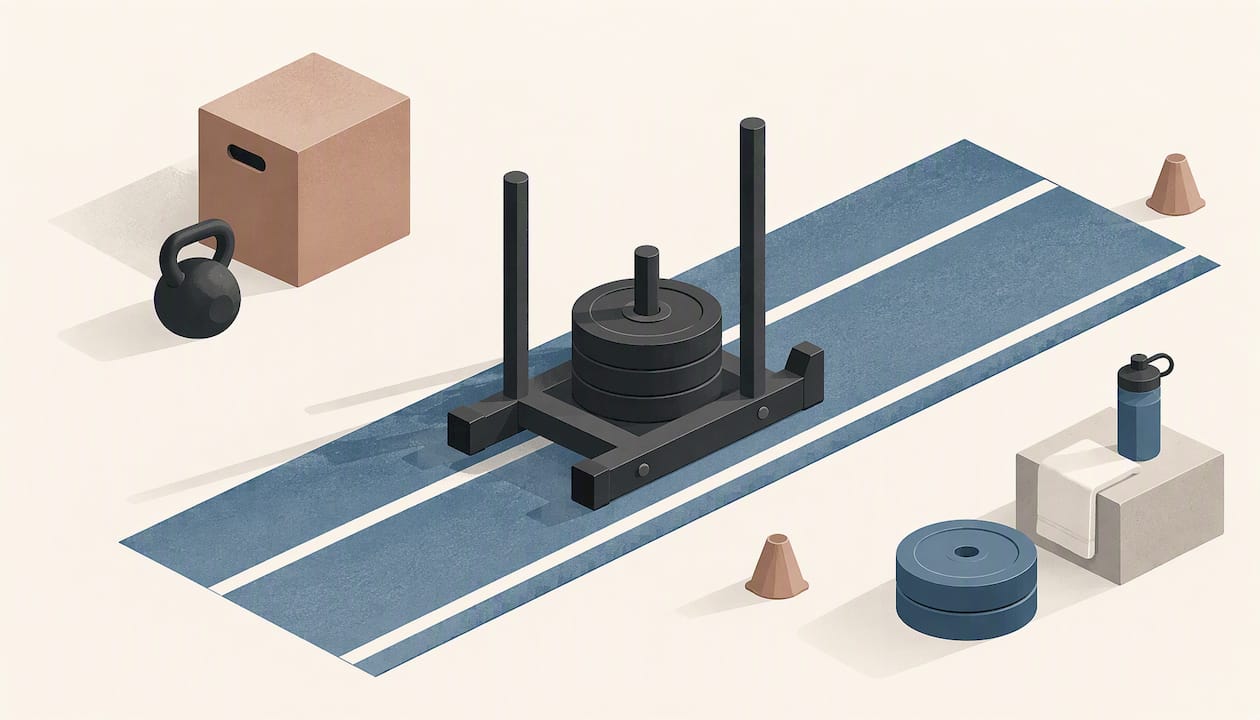
The sled push builds leg strength, lifts your heart rate and trains power, all in one move that is gentle on your joints. You load plates on a low sled, lean into it and drive it across the floor. There is no heavy bar to lower and no impact from landing. That is why it suits a 45-year-old desk worker as well as a teenage sprinter.
Below, we cover the muscles it works, what the research says, how it helps with fat loss and healthy ageing, how heavy to go and how to get started without hurting yourself.
A sled push is a strength and conditioning exercise. You place your hands on the upright posts of a low, weighted sled and push it along the floor, usually over 10 to 20 metres on turf or a smooth gym floor. Some people call the sled a prowler, which is just a popular brand-style name for the same kind of kit.
It sits somewhere between lifting and running. You are pushing a heavy load, like a leg press, but you are also moving, breathing hard and working through your hips, like a sprint. Strength coaches like it because it is simple to learn, easy to scale and hard to cheat.
How heavy is a sled? Empty gym sleds vary a lot. One guide to gym sled weights puts the empty weight of an average commercial sled at roughly 16 to 68 kg, before you add plates. The surface changes how hard it feels too: turf drags more than a polished floor. So two people pushing “60 kg” in different gyms can feel very different effort. Judge it by how it feels and how your form holds, not just the number.
The short answer is: almost everything below the chest, and a fair amount above it. Healthline’s breakdown of the sled push lists the quadriceps, glutes, calves, hamstrings, abdominals, hip flexors, chest, triceps and shoulders as the muscles involved.
Here is what each area does in plain terms:
| Muscle group | What it does in the push |
|---|---|
| Quads (front of thigh) | Straighten your knees to drive the sled forward. |
| Glutes (bottom) | Extend your hips with every step. The main engine of the push. |
| Hamstrings (back of thigh) | Help the hips and control the leg as it swings through. |
| Calves | Push you off the ball of your foot. |
| Core | Holds your body in one stiff line from head to heel. |
| Chest, shoulders, triceps | Transfer your leg drive into the sled through straight arms. |
If you sit at a desk all day, the glute part matters. Glutes that switch off from sitting can leave your lower back and knees doing extra work. If that sounds familiar, this piece on dead butt syndrome and self-tests explains the problem, and pushing a sled is one of the simplest ways to make your glutes work hard again.
Your body position changes the emphasis. A low, forward lean with long strides pushes more work to the glutes and hamstrings. A higher, upright hand position with shorter steps puts more load through the quads and upper body. Coaches use this on purpose, and it is one reason the sled is so flexible.
Most exercises make you pick: lift something heavy, or get out of breath. The sled does both. A set of 20 metres with a solid load builds leg strength and sends your heart rate up fast. For busy people, that is the big draw. You get two jobs done in a short block of time.
When you squat or deadlift, you lower a weight under control. That lowering phase is where a lot of muscle soreness comes from. On a sled push you only ever push. Because there is no lowering phase, many people find the next day feels better than after heavy lifting. That is a general pattern coaches report rather than a promise, and your own recovery will vary. You also do not land from a jump, so there is little impact through the knees, hips and back.
That makes it a handy option if you are returning to training, or if joints complain about running and jumping. Our guide to low impact strength training for 40+ covers the wider idea.
Sled work trains the first few steps of a sprint, the push-off phase where you go from still to fast. That matters for footballers, rugby players, sprinters and anyone playing a sport that starts with a burst. It also matters for ordinary life, where power helps you climb stairs, carry shopping or get up from the floor. We write more on this in strength and power training for adults.

There is no complicated technique to master. You push. That means beginners can get a hard session out of it within minutes, and coaches can spot form problems quickly.
Change the load, the distance, the speed or the rest time and the same exercise suits a new member or a trained athlete. Group sessions can use one sled for people of very different levels because each person simply loads it differently.
Resisted sprint training means sprinting or pushing against extra load, usually a sled. Here is what UK studies have found.
The most useful finding for planning your training is about load. A 2025 systematic review and meta-analysis from Abertay University found that resisted sprint training is effective for improving acceleration, but the right load depends on the person and the goal. Very heavy loads tend to suit well-trained athletes who want maximum force. Lighter loads can be enough for recreational trainers and young people, and smaller amounts of heavy work can give results similar to larger amounts of light work.
In plain words: more weight is not automatically better. The best load is the one you can push with good form and a clear purpose.
People often mix up the sled push and the sled sprint (or sled tow), where you wear a harness and pull the sled behind you. Both are resisted sprint training.
| Sled push | Sled sprint (tow) | |
|---|---|---|
| Body position | Leaning forward, hands on the sled | Upright running, harness at the waist |
| Best for | Strength, power, first steps | Sprint mechanics with extra drag |
| Typical load | Light to heavy, by goal | Usually lighter, so running form holds |
| Skill level | Beginner friendly | Needs some running technique |
For most adults, the push is the easier place to start. For young athletes, a coach will often use both, depending on what the athlete needs to improve. The Abertay review adds that sled training can help coaches see whether an athlete is held back more by force or by speed, so the next block can target the right gap.
The sled push will not melt fat on its own, and no single exercise does. What it does well is make your session count. It uses big muscles, raises your heart rate quickly and keeps you moving for short, hard efforts. Over weeks, that can help you burn more energy and build muscle, which supports a healthier body composition.
Three things make it practical for fat loss:
Food and sleep still do most of the work. If weight loss is your aim, our article on losing weight after 40 with two strength sessions a week lays out a realistic plan.
The UK Chief Medical Officers’ guidelines say adults should build strength on at least two days a week, alongside aerobic activity. You can read the full UK Chief Medical Officers’ physical activity guidelines on GOV.UK, and the announcement of the updated guidance explains the focus on strength throughout life. The NHS adds that strength exercises help increase muscle strength, maintain bone density, improve balance and reduce joint pain.
A sled push counts as strength work because it makes your muscles work harder than usual. It also doubles as cardio, so one short session ticks more than one box. That is useful when your week is full of work, family and everything else.
If you want the bigger picture, these articles go further:
A note on safety. If you have not exercised for some time, or you have a heart condition, high blood pressure, a back problem or any other medical condition, speak to your GP before starting hard conditioning work. The NHS guidance for adults aged 19 to 64 says the same.
You need a sled, a flat run of 10 to 20 metres and a bit of space to turn. Most gyms with turf have one. If you are new, ask a coach to watch your first few pushes.
If your back rounds or your steps become a shuffle, the load is too heavy. The research notes that those new to the movement should use low loads and good-quality repetitions before adding weight.
Do this once or twice a week. After three or four weeks, add a little weight or one more push, never both at once.
| Your goal | Load feel | Typical effort |
|---|---|---|
| Learn the movement | Very light | Smooth, easy, perfect form |
| General fitness and fat loss | Light to moderate | Breathing hard, steps still quick |
| Strength and power | Moderate to heavy | Short push, long rest, form held |
| Athlete acceleration | Set by a coach | Tracked by speed drop-off |
These are rough guides, not prescriptions. A coach can set the right load for your age, history and goal.
We like the sled push for the same reason we like most simple things: it works, and people keep doing it. A lot of people over 40 come to us worried that strength training means heavy lifting, sore days and injury risk. The sled takes much of that worry away. It is hard in the right way, it is easy to adjust for each person and it leaves you feeling capable, not wrecked.
Our approach at Unit is small group personal training, where each person has a plan that fits them. That matters for sled work more than most exercises, because the load that suits one person is wrong for the next. In the same session, one member might push a light sled for form and breathing, while another pushes a heavier load for power. A coach is watching both, adjusting as they go.

For young athletes, our programmes are led by an experienced strength and conditioning coach, and acceleration is a big part of that. Again, the load is chosen to match the athlete, which fits what the research says.
Our advice is simple. Do not chase big numbers. Get the position right, push with purpose, and come back next week. Consistency beats intensity in the long run.
— Vitalij
If you would rather not work it all out alone, we can help. Small group personal training at Unit Health & Performance gives you an individual plan, expert coaching and a supportive, non-intimidating community in Sheffield. If you prefer a class format, take a look at our fitness classes. Parents of young athletes can see our speed, agility, strength and power work on the youth athlete programme page. You can also start from our home page.
It is a full-body strength and conditioning exercise. You push a weighted sled along the floor, which works your legs, hips, core and upper body while raising your heart rate. It counts as both strength work and cardio.
Yes, if you start light and keep your back flat. There is no lowering phase and no impact, which makes it friendlier than many lifts. Ask a coach to check your position on the first few sessions, and speak to your GP first if you have a medical condition.
Once or twice a week is plenty for most adults. That fits neatly with the UK guidance of strength work on at least two days a week, as long as your other sessions cover the rest of your body. Leave a rest day between hard sessions at first.
Empty sleds vary by model, with one guide giving a range of about 16 to 68 kg before plates. The floor surface also changes how heavy it feels. Choose a load based on form and effort rather than the number alone.
It can help as part of a wider plan. It burns energy, builds muscle and is quick to do, but your food, sleep and overall routine matter just as much. Treat it as one useful tool, not a shortcut.