Strength training is one of the most useful things you can do during perimenopause and menopause. Aim for at least two sessions a week, use weights that feel properly hard by the last few repetitions, and keep going for months, not weeks. It protects muscle and bone, which both decline faster as oestrogen falls. It won’t cure hot flushes, and we’ll be straight about that below.
This guide explains what to do, how often, how to start safely, and when to check with a professional first.
Around menopause, oestrogen drops. That has two effects on your body that you can do something about.
First, muscle. Muscle naturally declines with age, and strength work is the most efficient way to build it back or hold on to it. The British Menopause Society says regular strength exercise helps build and maintain muscle, which in turn supports your metabolic rate. Many women notice their body shape changing, with more fat around the middle. Strength-based exercise can help with that.

Second, bone. Lower oestrogen speeds up bone loss. According to Cambridge University Hospitals, one in three menopausal women in the UK will have an osteoporotic fracture, around 536,000 people each year. Bone loss is quiet. The Royal Osteoporosis Society points out that many people put height loss down to ageing when it can be a sign of spinal fractures, and its Great British Bone Check exists so people can spot risk factors early.
NICE agrees on the principle. Its menopause guideline (NG23) says healthcare professionals should explain why strength training matters for keeping muscle mass and strength through the menopause transition.
The point is not to look a certain way. It is to stay strong, steady and independent for the next 30 or 40 years.
The short answer: twice a week, full body, and make it challenging.
The American College of Sports Medicine suggests full-body resistance training at least two to three times a week, and UK guidance sits in the same place at a minimum of two. The Government’s evidence review on muscle and bone strengthening backs the importance of strength and balance activity for bone and muscle health.
What “hard enough” means in practice:
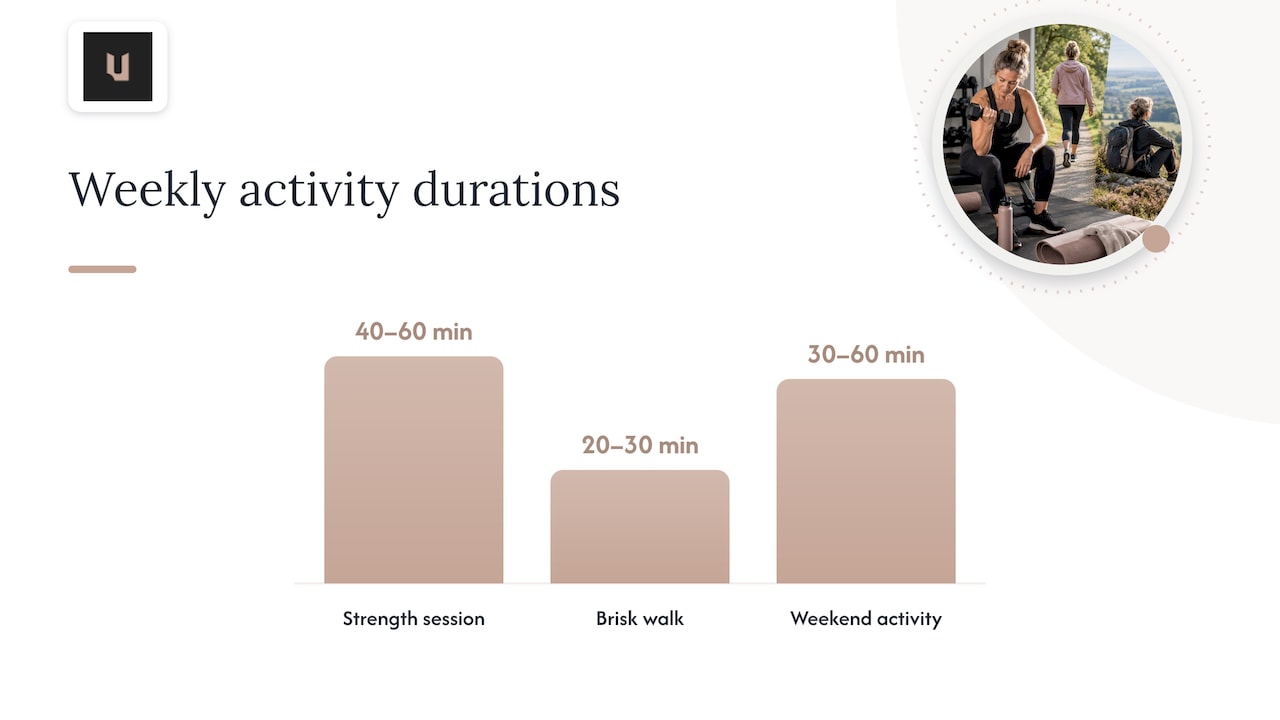
A sample week for most busy people:
| Day | What | Time |
|---|---|---|
| Monday | Full-body strength session | 40 to 60 min |
| Tuesday | Brisk walk | 20 to 30 min |
| Thursday | Full-body strength session | 40 to 60 min |
| Weekend | Longer walk, cycle or swim | 30 to 60 min |
The NHS guideline for adults also recommends at least 150 minutes of moderate activity a week, so strength work sits alongside walking, not instead of it. If you want the wider picture, our guide to training for longevity after 40 explains how the two fit together.
Consistency beats intensity. Two sessions you actually do each week beat one brutal session followed by two weeks off. The British Menopause Society’s guidance and its experts say the same: steady effort over time is what counts, particularly if your diary is already full.
You don’t need a long list. Build your session around these movement patterns:
Some expert round-ups also name squats, deadlifts, hip thrusts, Bulgarian split squats, press-ups and pull-ups as favourites. They are all variations of the patterns above. Start with the easy version of each and progress when it feels solid.
A beginner session might look like this:
Rest for 60 to 90 seconds between sets. Warm up with five minutes of easy movement first.
No. Strength is your ability to produce force, and you can improve it without big increases in muscle size. A Government guide on the science of human performance makes this point, noting that women need frequent strength sessions to gain and keep strength. For most women in midlife, the visible change is firmer, more capable and leaner, not bulkier.
Bones respond to load. Lifting weights and impact activity, like brisk walking or controlled jumping, tell your skeleton to hold on to its density.
Two things to know:
If you have osteoporosis, low bone density or a previous fracture, speak to your GP or a specialist before you start, and train with a qualified coach who knows your history. The Royal Osteoporosis Society says most people with osteoporosis can exercise safely, but the exercises you choose matter. Moves that round the spine forward, such as deep sit-ups and crunches, often need changing when bone density is low. The British Menopause Society also advises modifying certain floor-based movements if bone density is low, and a trained coach can do that for you.
This is where honesty matters. Exercise is good for your mood, sleep, heart and general wellbeing. NICE guidance for clinicians says a healthy lifestyle can improve menopause symptoms, prevent chronic disease and improve wellbeing. But evidence that exercise directly reduces how often or how severe hot flushes are is limited and inconsistent.
So think of training as a stabiliser. Many women find they cope better with symptoms when they are sleeping better, feeling stronger and have a routine to lean on. It is part of the picture, not a stand-alone fix.
If symptoms are affecting your life, talk to your GP. Treatment options, including HRT, are a medical conversation. If poor sleep is the main issue, it can help to go in prepared, and this checklist of questions to ask before using progesterone for sleep is a useful starting point for that chat.
The scale is a blunt tool. The British Menopause Society says there is high quality evidence that combining a lower-calorie diet with more exercise, including strength exercise, is the route to keeping weight off long term, and that this includes reductions in waist size.
Better ways to track progress:
Muscle is denser than fat, so you can get smaller without the scale moving much. If weight loss is your goal, our guide on losing weight after 40 with two strength sessions a week goes into more detail.
If you are in your fifties or beyond, two simple start plans for strength training over 50 may help you pick a starting point. For a general overview, see strength training for over 40s.
We work with people over 40 every day, and the same obstacles come up again and again. People don’t know what to do in a big gym. They worry about doing it wrong. They start hard, get sore and quit. Or they train alone, with no one noticing if they stop.
That’s why we built our approach around small group personal training. You get an individual plan based on your body, your history and your goals, and a coach watching your technique. You also train alongside other people, which makes it easier to keep turning up. For menopause, that matters. Consistency is what builds muscle and protects bone, and a supportive, non-intimidating setting is what keeps most people consistent.
Our view is simple. Lift properly, twice a week, progress slowly, and don’t expect one session to do what months of training will. Pair it with walking, decent sleep and enough protein, and ask your GP for help with symptoms that are getting in your way.
— Vitalij
If you would like help getting started, our small group personal training in Sheffield is built for adults over 40. Each member has an individualised plan, and our coaches make sure every session has a purpose. If you prefer a class setting, take a look at our fitness classes. Tell us about any medical history, including bone density results, before your first session so we can plan around it. You can also visit our home page to get in touch.
At least twice a week is the UK guideline for strengthening activity. Two to three full-body sessions is a good target for most women. Leave a rest day between sessions so your muscles can recover.
Not reliably. Current NICE guidance recognises that evidence for exercise reducing hot flushes is limited. It does help with mood, sleep and overall wellbeing, which can make symptoms easier to live with. If hot flushes are hard to cope with, speak to your GP about other options.
Most people with osteoporosis can exercise safely, but the choice of exercises matters. Speak to your GP or specialist first, then train with a coach who can adjust movements, especially anything that bends the spine forward under load. Don’t copy a generic programme from the internet.
You might see the scale stay similar while your body changes, because muscle is denser than fat. Track your waist, hips and how your clothes fit as well as your weight. Combined with a sensible diet, strength training supports long-term weight management.
No. You can begin with dumbbells, bands and your own body weight. A gym or coach becomes useful when you want heavier weights, checked technique and a plan that progresses for you.