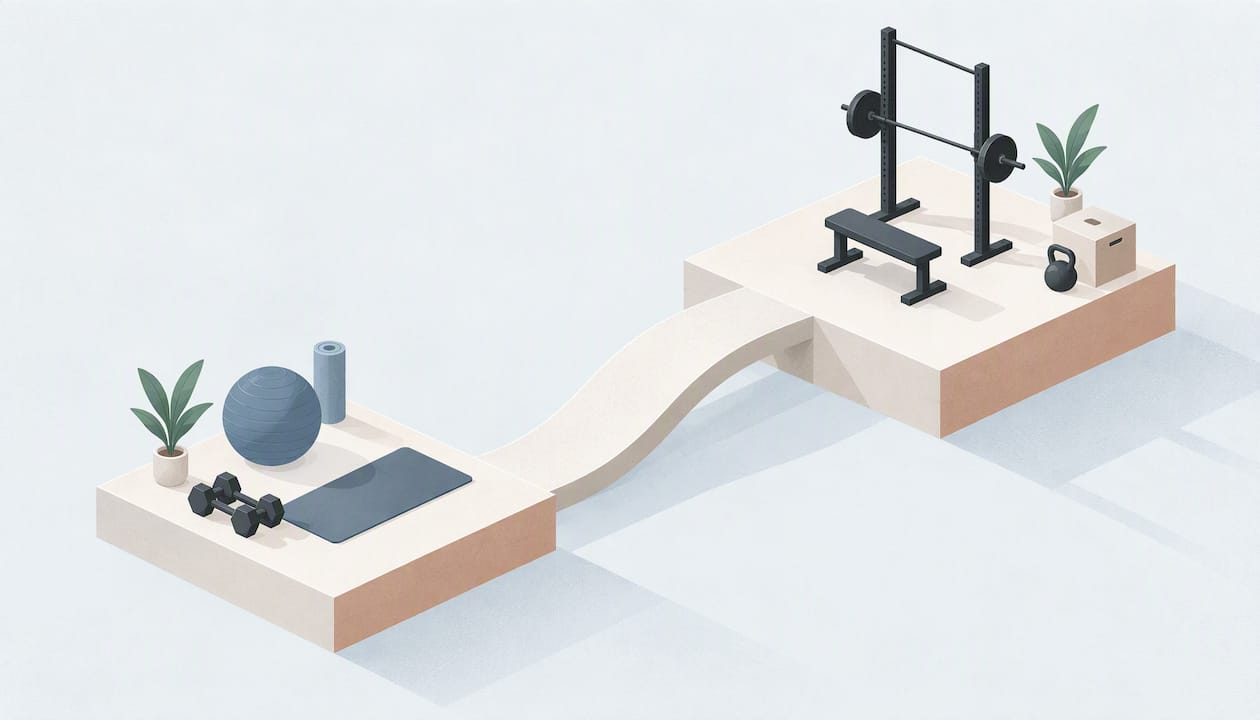
For most people with ordinary back pain, strength training is not something to avoid. It is part of the way back to feeling normal. The NHS advises staying active and carrying on with normal activities where you can, and it says to stop an exercise if the pain gets worse. The aim is to find what your back can cope with today, then build from there with lighter loads, simpler exercises and steady progress.
This guide explains how to do that in plain terms. It covers how to judge your pain during a session, which exercises are sensible to start with, how to train your core, whether deadlifts are off the table, and when to get medical help instead.
In most cases, yes, with some changes. NICE, the body that sets NHS guidance in England, says exercise and movement may help ease symptoms of low back pain and sciatica, and that a healthcare professional should talk through suitable types with you. Its main guideline adds that people with a flare-up may be offered a group exercise programme, chosen to suit their needs, preferences and capabilities.
The research on strength work is encouraging too. A meta-analysis of studies on people with non-specific chronic low back pain found that resistance training reduced pain intensity and disability. A 2021 clinical guideline also recommends exercise for chronic low back pain, including strengthening and endurance work for the trunk muscles.
“Non-specific” simply means no clear structural cause has been found, which is the case for most back pain. If your pain follows a fall or accident, spreads into your legs with numbness or weakness, or has lasted a long time without a diagnosis, speak to your GP or a physiotherapist before you build a programme.
NICE also advises against relying on belts, corsets, traction or electrotherapy for non-specific low back pain. Movement and strength are the better bet.

Put safety first. Get urgent help from your GP or NHS 111 if you have back pain and feel hot, cold, shivery or generally unwell, or if the pain is severe, started suddenly or is getting worse quickly.
Sharp or burning pain after a lift is also a reason to stop. HSS, a US hospital for musculoskeletal care, says to stop a lift if you feel pain and get a medical evaluation if acute, sharp or burning pain follows.
Numbness in the saddle area, loss of bladder or bowel control, or weakness in a leg are emergencies. Go to A&E rather than waiting for a gym session to settle it.
The hardest question is how much pain is too much. One simple answer comes from an NHS physiotherapy leaflet. St George’s NHS Foundation Trust uses a traffic light system based on how bad the pain feels out of 10:
| Light | Pain level | What to do |
|---|---|---|
| Green | 0-3 out of 10 | Carry on with the exercise |
| Amber | 4-6 out of 10 | Carry on, but adapt the exercise |
| Red | 7-10 out of 10 | Stop and seek medical advice |
The same leaflet says amber pain can be handled by making the exercise easier: less weight, fewer repetitions, lower intensity or a smaller range of movement.
A second rule is about timing. A hospital leaflet on low back exercises advises reducing your repetitions if pain lasts more than two hours after exercise. So check how you feel that evening and the next morning, not only during the session.
NHS Fife offers an easy way to remember the approach, called the three Ps: Pace, Plan and Prioritise. Pause before the pain builds, break tasks into smaller parts, and drop the “no pain, no gain” idea.
When your back is sore, you rarely need to stop training. You change one thing at a time. Professional guidance suggests that reducing load, changing exercises or modifying your routine for a while is often enough, and that complete rest during an acute bout may slow recovery.
Here are the changes that usually help most:
Walking, swimming, yoga and Pilates can also help, according to the NHS. They make good extra days alongside your strength work. If you want ideas for easy days, our guide to rest day routines for gym goers has three low-load options.
An NHS leaflet on low back pain exercises gives these examples: sit-to-stands, supported bent-over rows, glute bridges, front planks, standing knee raises, wood chops and light Romanian deadlifts. They work the legs, hips, back and trunk without needing anything complicated.
Here is how that could look as a first session:
| Exercise | What it trains | Easy starting point |
|---|---|---|
| Sit-to-stand | Legs and glutes | Use a high chair, no weight |
| Glute bridge | Glutes, back of legs | Both feet on the floor, pause at the top |
| Supported bent-over row | Upper back | Chest on a bench, light dumbbell |
| Standing knee raise | Hips, balance | Hold a wall for support |
| Wood chop | Trunk rotation | Light cable or band |
| Front plank | Whole trunk | Knees down, 10 to 20 seconds |
The leaflet gives 3 sets of 10 as a guide for the Romanian deadlift. For the rest, start with one or two easy sets and add more over a few weeks.
Something you may find reassuring: Cambridge University Hospitals says research has not shown that a supposedly correct lifting technique prevents back pain or injury. It suggests using the posture that feels most comfortable and pacing repetitive lifting. You do not need a perfectly flat back to be safe. You do need to find positions that feel good to you.
If knees or shoulders also complain, we have separate guides on strength training with knee pain and shoulder friendly pressing.
Many people search for core work as soon as their back hurts. The core is the group of muscles around your trunk, and training it is a reasonable part of the plan. Just keep it controlled and gentle at first.
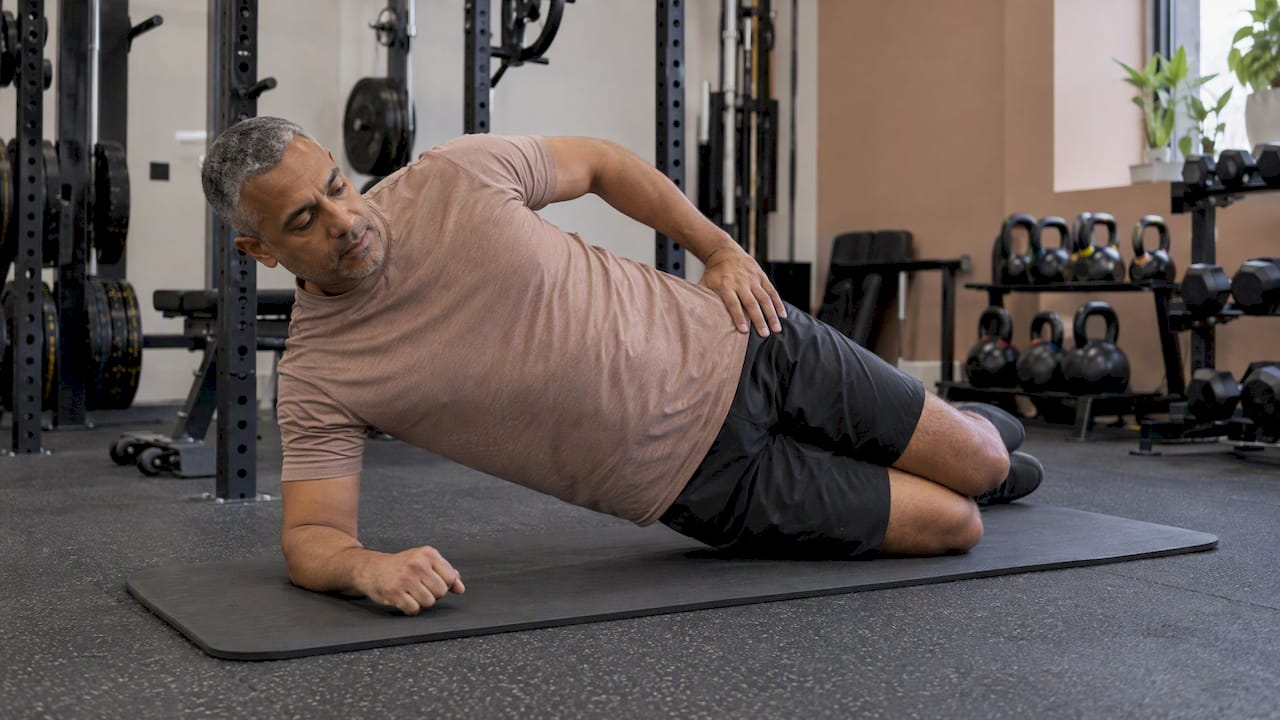
The Chartered Society of Physiotherapy lists core activation, controlled heel slides with a neutral back, and pelvic tilts as starting exercises. When those feel easy, NHS Fife’s leaflet adds partial curl-ups, four-point kneeling bracing, bird-dogs and modified planks. Another hospital trust lists cat-camel movements, bird-dog variations, prone lifts and side planks as the next stage.
A simple order of progress looks like this:
Once you can hold your trunk steady, you can start adding load while you brace. This guide to loaded stability core work shows how to progress core strength over several weeks.
HSS also notes that planks and side planks help activate the core for lifts, so the core work is not a separate task. It makes your leg and back exercises feel steadier.
They can be, if you start light and keep the movement simple. The NHS leaflet we mentioned includes the Romanian deadlift in its exercise list. It describes hinging at the hips with a straight back, lowering only until you feel a slight stretch in your hamstrings, then driving the hips forward, with the core braced throughout.
A few practical points:
A hospital low back programme advises doing the exercises 3 to 4 times a week, with at least one day off between sessions. That is a rehab plan, so if you are already training and feeling fine, two or three well-planned strength sessions a week are plenty. Our guides on two sessions a week for over 40s and low impact strength training show how that can work.
University Hospitals Sussex describes safe rehabilitation as resting on four things: individuality, progression, overload and recovery. In plain words:
A good rule is to change one thing per week. If your back feels fine the day after, you can keep the change. If it does not, go back a step.
Our view: why coached small groups suit a sore back
We work with a lot of people over 40, and the pattern is familiar. Their back starts to hurt, they stop lifting, they get weaker, and the back gets more sensitive. Then they feel nervous about starting again.
What helps most is not a perfect programme on paper. It is having someone watch you move and say, “drop the weight a little today” or “that variation suits you better”. That is why we built our training around small groups with individual plans. Everyone in the room is doing something matched to them, and a coach is there to adjust it on the day.
We also believe the setting matters. People who feel judged tend to push too hard or give up. A friendly, non-intimidating gym where others have similar worries makes steady, sensible progress much easier.
We are not physios, and we do not diagnose pain. What we do is build strength carefully, using light loads and gradual steps, and we encourage you to see your GP or a physiotherapist when something needs checking.
Vitalij
If you would rather not work it all out alone, our small group personal training in Sheffield is built for adults who want to get stronger, leaner and fitter, including those who are returning after a sore back. You get an individual plan, a coach on the floor and a small group around you for support.
If you prefer a class setting, take a look at our fitness classes, or see everything we offer on the Unit Health & Performance homepage. Tell the coach about your back before your first session so they can plan around it.
For ordinary back pain, the NHS advises staying active and continuing normal activities where possible. Try gentle exercises and stretches, and stop any exercise that makes the pain worse. Long periods of bed rest are not usually recommended.
Lower the weight, shorten the range of movement and slow the pace. Support your body where you can, for example with your chest on a bench for rows. If the pain climbs to 4 to 6 out of 10, adapt the exercise. If it reaches 7 or more, stop.
Start with pelvic tilts, heel slides and gentle bracing. Then move on to bird-dogs, modified planks and side planks. Build up gradually and keep each movement controlled. If any exercise sends pain down your leg, stop and ask a physiotherapist.
Mild muscle soreness can be normal when you begin something new. However, if pain lasts more than two hours after exercise, an NHS programme advises reducing your repetitions next time. Sharp, burning or worsening pain is different and needs medical advice.